

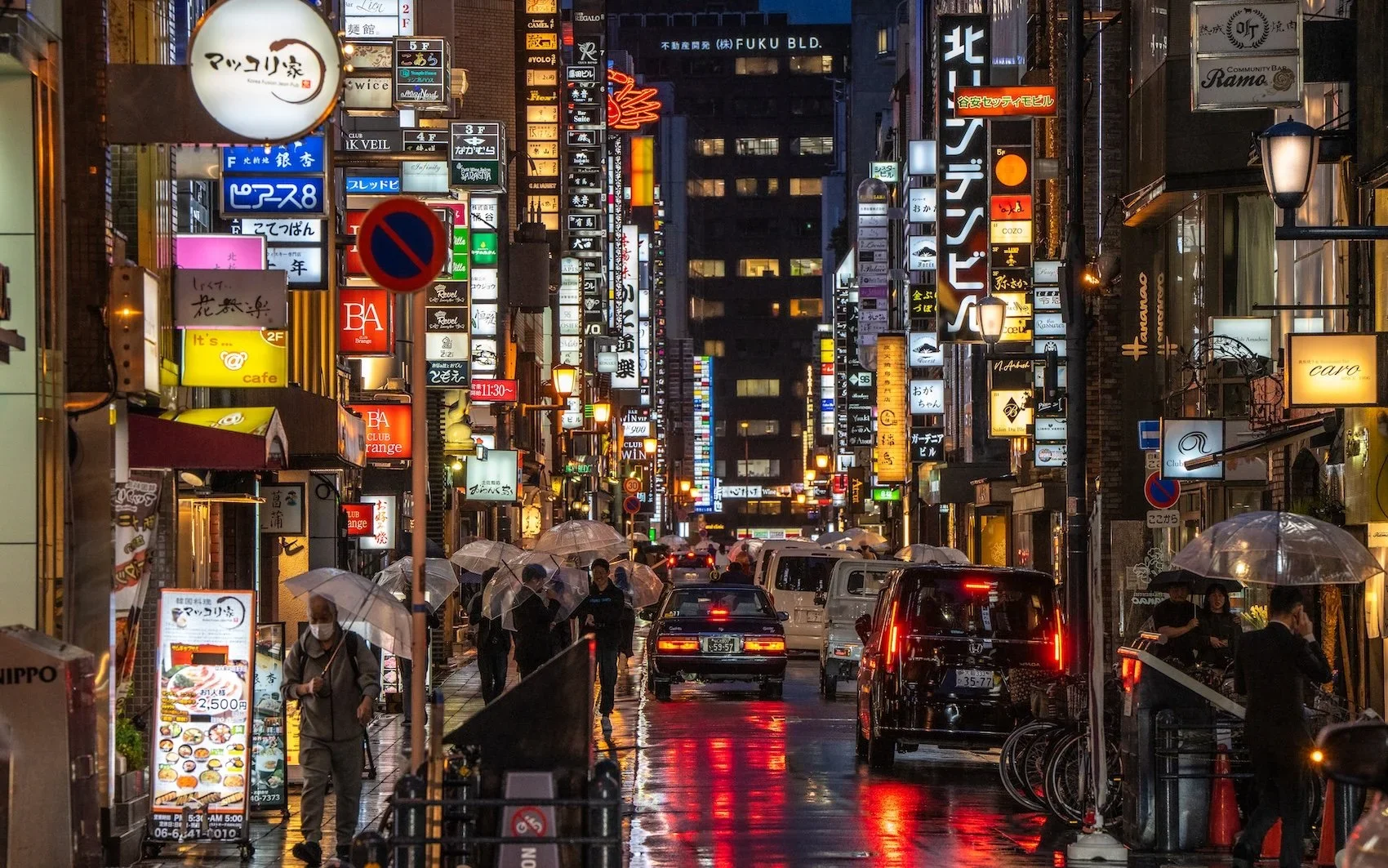
Where Tokyo Begins
It All Begins Here
When you arrive in Japan—especially Tokyo—there’s this immediate, overwhelming question: Where do I even start?
It’s dense. It’s beautiful. It’s layered in a way that makes you realize pretty quickly that no amount of planning will ever feel like enough.
Knowing that, I tried to be intentional. I pre-planned a few anchors for the trip: hit at least three cities, take a high-speed train, wander a few markets, check off some of the “must-see” spots. The usual stuff. But when it was all said and done, the only real feeling I had was wishing I could stay longer.
My first trip was two weeks. Honestly, I wish it had been a month. Or ninety days.
Because at first, you do want to get the touristy things out of the way—the big sights, the temples, the landmarks. Mount Fuji, of course. And then there’s the food. Always the food.
But Japan reveals itself slowly. For such a relatively small country, it feels vast. Every city has its own rhythm. Every neighborhood feels like a different world. And the more time you spend there, the more you realize how much you’re still missing.
From immersive digital spaces like teamLab, to dense downtown streets glowing at night, to quiet, traditional areas that feel untouched by time—it’s all there. And then, somehow, the food still manages to be the highlight.
Street photography, especially, is incredible in Japan. If you like heading out with a small camera and simply observing—architecture, signage, people, texture, light—it’s hard to beat. At first, I thought the rain might get in the way. Too wet. Too messy. But then I realized it was perfect. The reflections. The color. The way everything comes alive.
Tokyo alone could take a lifetime. One of the largest cities in the world, made up of countless distinct pockets, each with its own personality. You can wander endlessly and never feel like you’ve seen the same thing twice.
If you have any real freedom in your schedule, trust me—whatever time you plan won’t be enough. You’ll already be thinking about the next trip before the first one ends.
And that’s probably a good place to leave this one.
More to come.
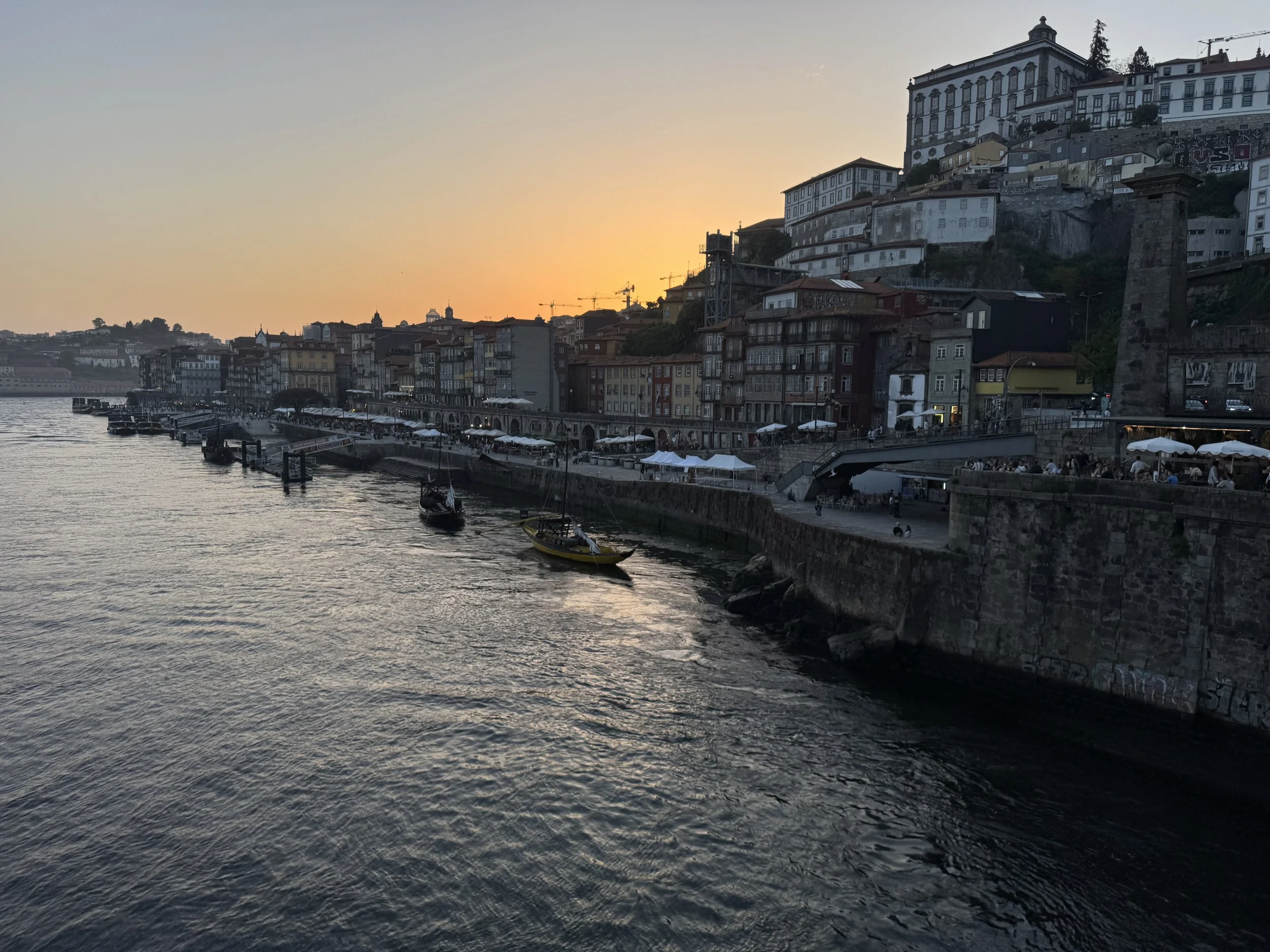
Porto, Like a Postcard
Portugal.
Porto, specifically.
From the moment you arrive, it feels like you’ve stepped into a postcard—or maybe out of one. It’s hard to tell which. Either way, the feeling sticks.
You arrive, make your way down toward the water, and suddenly everything opens up. Boats moving slowly along the river. A bridge connecting the two sides of the city. Cable cars climbing the hills. Restaurants stacked into the hillside. People everywhere. Life happening in layers.
It really does feel magical. Dreamy, even.
What’s most striking is how the city is built into itself. Porto doesn’t sit beside the water—it leans into it. Buildings rise organically from the river’s edge, worn and beautiful, full of history and texture. Travelers from all over the world come for this exact reason: the architecture, the layout, the light, the scene.
And of course—the food and the drinks are world class.
The photographs almost take themselves. Every direction offers another frame. In some places, it reminded me of Spain, and we did make our way to Lisbon as well, but Porto has its own gravity. Slower. More intimate.
It’s also incredibly walkable. For not much money, you can stay in a small, charming hotel near the water and spend your days wandering—through history, music, museums, and art. One afternoon led to a world-famous bookstore, where I found one of my favorite books, The Old Man and the Sea by Ernest Hemingway. That felt like one of those small, perfect travel moments you don’t plan for.
Sunsets here are something special. Soft, golden, reflective. The kind that makes you slow down, take a few photos, and then quietly plan the next day.
The place we stayed had sister hotels throughout Europe—and even its own winery. Drinking wine from the place you’re staying adds a subtle kind of magic. An extra layer you don’t forget.
So once again, my advice is simple:
Get there. Walk everywhere. Soak it in.
Porto rewards presence.
Porto, Portugal
Words and photograph by Tony Frantz
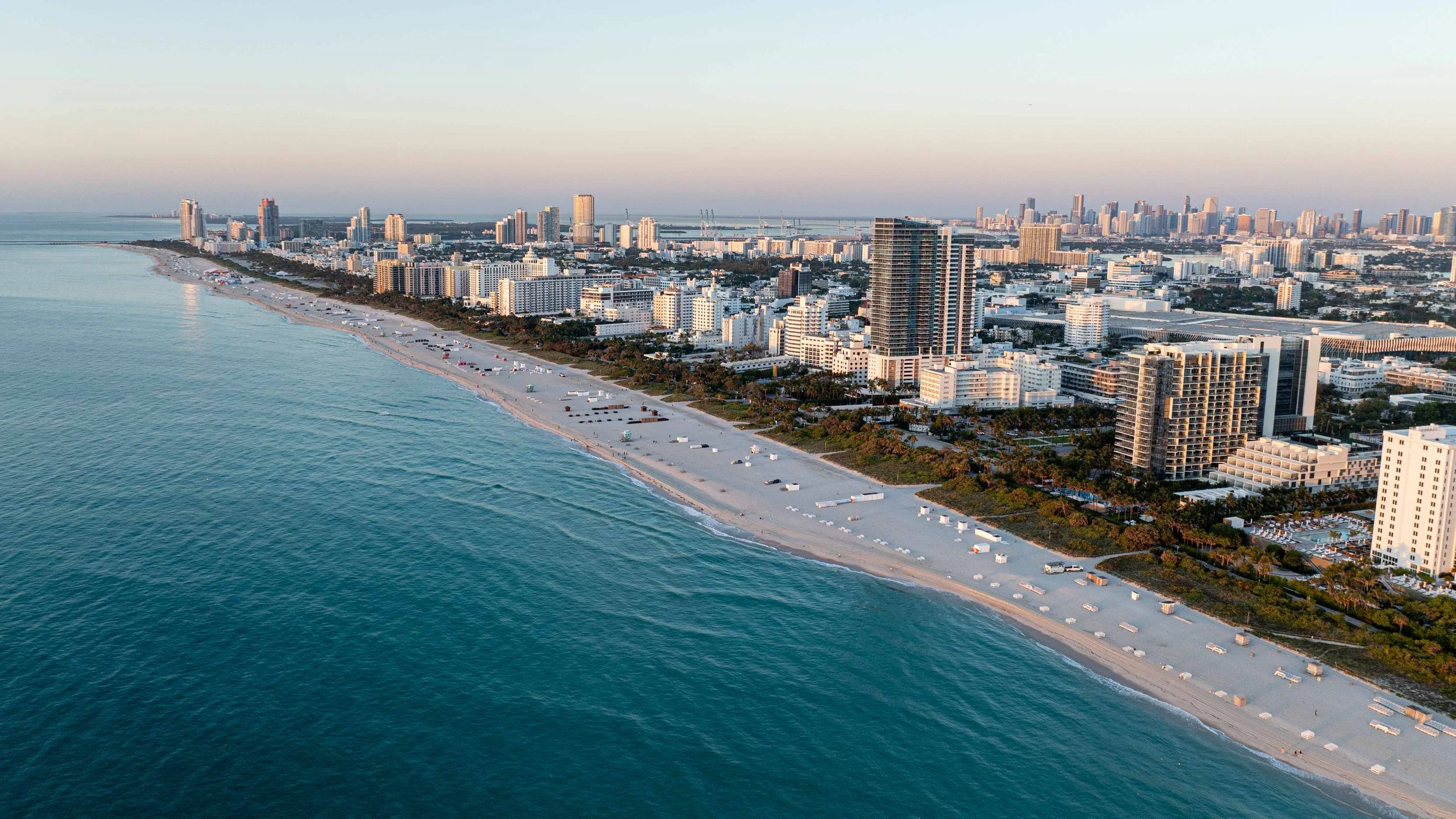
Miami in Layers
It All Begins Here
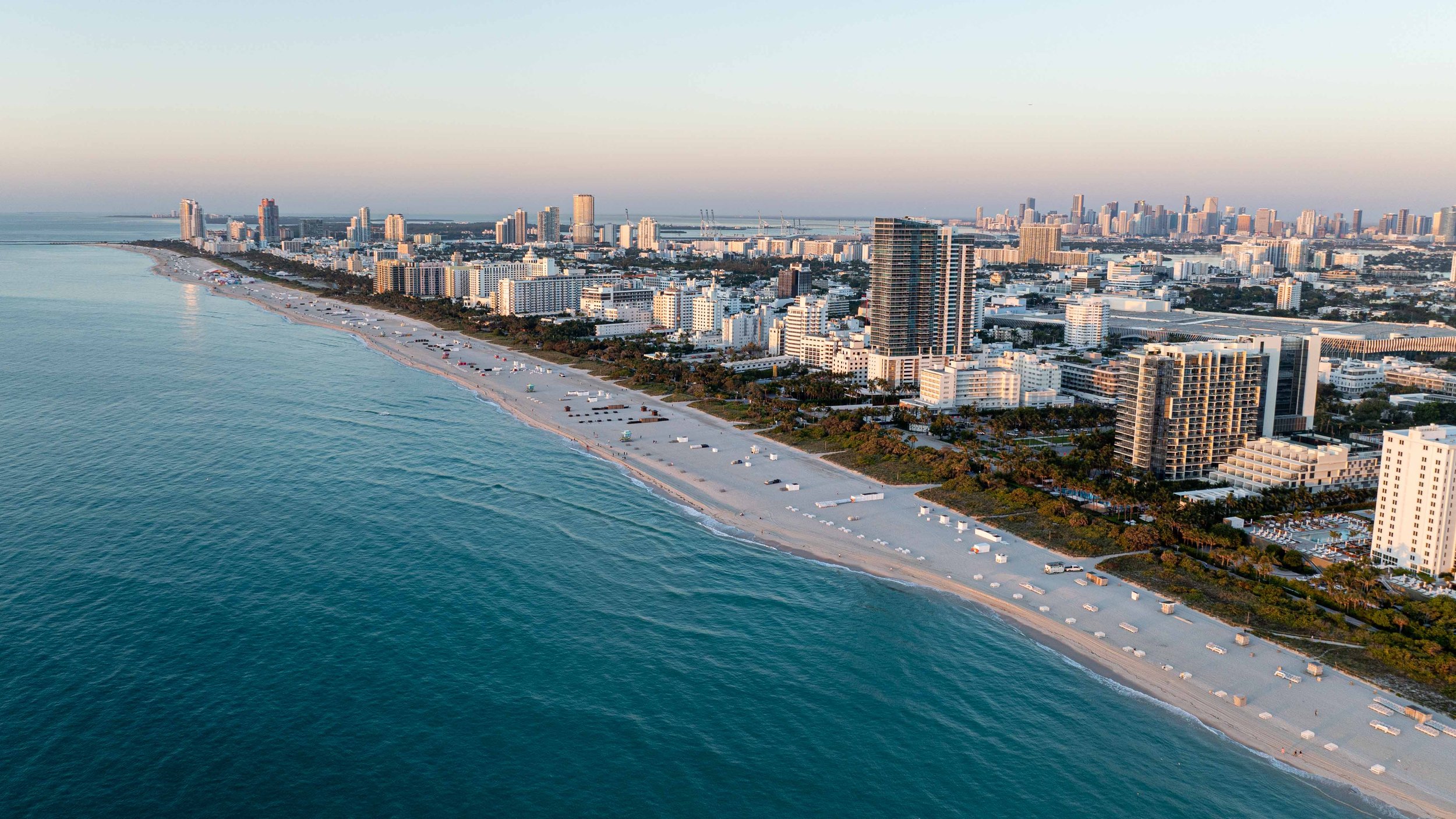
Flying into Miami hits you immediately.
You land, grab an Uber or a taxi, and within minutes you’re surrounded by heat, color, density, and motion. It’s one of those cities where the transition from airport to street already feels like part of the experience.
For this trip, I split my time.
Half in Brickell—Miami’s downtown core—where everything rises vertically. Tall buildings. Big business. Luxury. Restaurants, shops, energy. It’s fast, polished, and undeniably modern. Hot weather, good food, and a sense that things are always happening just out of view.
Highly recommended.
But equally important: get to the beach.
For me, the key was absorption. Spend time walking Brickell. Sit somewhere. Watch how the city moves. Check out a few spots. And yes—this is touristy, but worth it—hop on one of those buses that loop through the city. It’s an easy way to see how Miami is stitched together. Little Havana. South Beach. Neighborhoods that feel completely different from one another.
That’s really the decision you make in Miami:
Downtown or beach.
Hotels in the city or hotels by the water.
Both are great. You just have to choose how you want to split your time.
One of the most exciting things about Miami—beyond the obvious—is that it’s still evolving. Still building. Still renovating. Still becoming. It feels like a city actively deciding what it wants to be next, and that energy is everywhere.
And when you do get to the beach, it’s hard to only do beach time.
The Art Deco architecture is so present, so alive, that it pulls you off the sand and back into the city. You want to walk. You want to explore. You want to see museums, galleries, details you didn’t expect.
But don’t skip South Beach.
The light. The water. The people. The scale of it all. It’s a global hotspot for a reason. Day shoots. Night scenes. Neon, shadows, movement. There’s no shortage of moments—or images—waiting to be made.
I’ll leave this one here for now.
More to come. I brought back plenty.
Miami, Florida
Words and photographs by Tony Frantz
First Light in Bar Harbor
It All Begins Here
Photo by Tony Frantz
Getting to Maine—and more specifically Bar Harbor—takes commitment.
It’s a haul for most people, whether you’re driving from the East Coast, coming in from the Midwest, or flying nearby and finishing the trip by car.
But if you time it right, the journey becomes part of the reward.
My suggestion: arrive early. Really early.
There’s something about pulling through those small towns and winding roads as the morning light first arrives. The sun lifts slowly, reflecting off narrow waterways and quiet inlets, revealing the landscape piece by piece. By the time you reach Bar Harbor, the place has already introduced itself—subtly, patiently.
It’s hard to explain. You kind of have to experience it yourself.
Once you arrive, find a place to eat. There’s no shortage of options, even early in the morning. Lobster omelets. Lobster rolls. Or one of the best things I’ve ever eaten—a lobster cake, which I suppose is technically a lobster crab cake, but whatever you call it, it was incredible.
The light here is unreal.
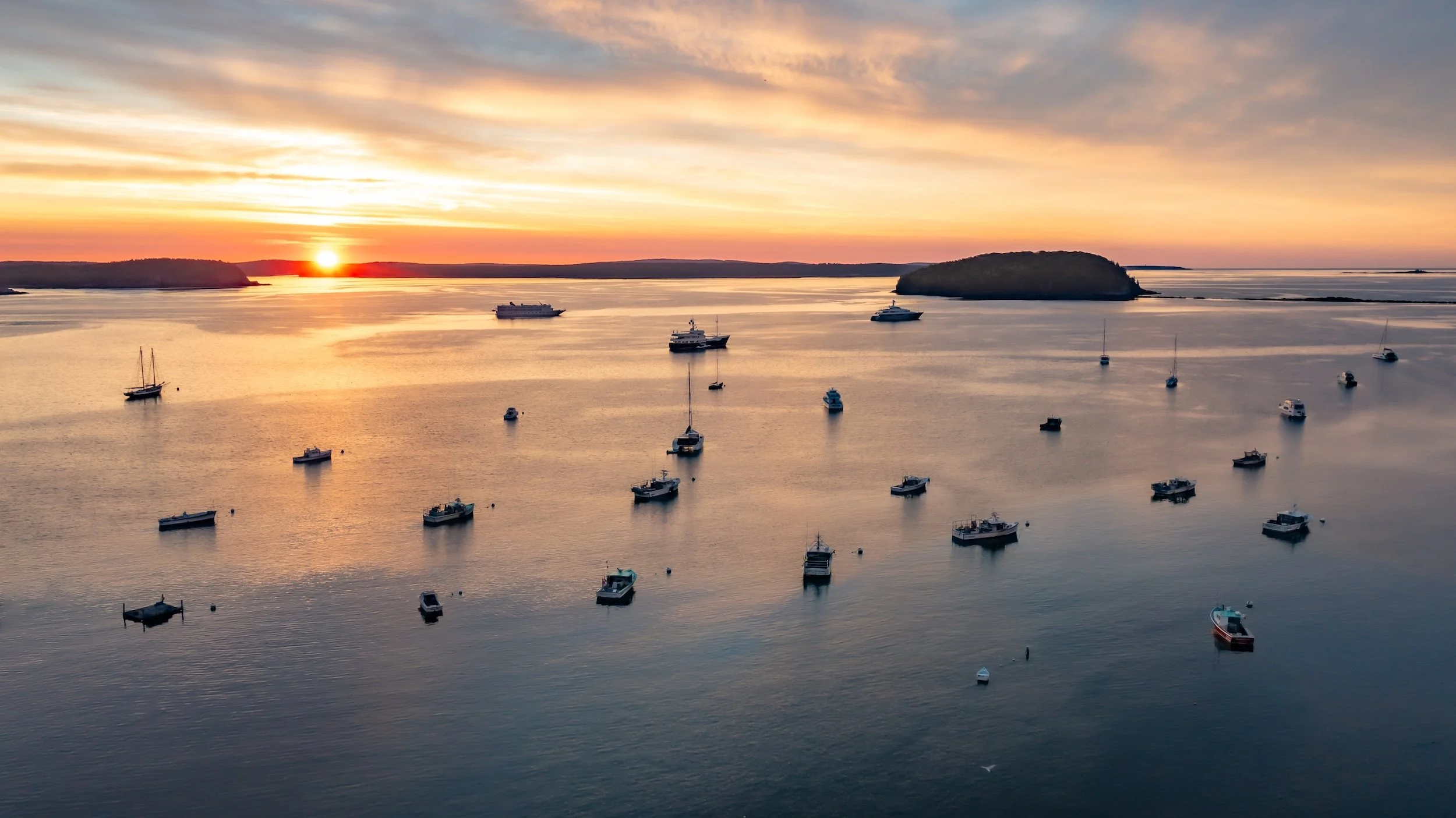
This image is from early morning, shot by drone, capturing that first glow as it spreads across the harbor. Boats resting. Water barely moving. A calm that feels almost borrowed from somewhere else. It reminds me of Norway—at least the version of Norway I imagine. That soft, northern light that people travel across the world to see.
Bar Harbor rewards early risers.
Get up before the town fully wakes. Walk everywhere—it’s one of the most walkable places I’ve ever been. Watch the harbor come to life. The boats, the birds, the people easing into the day. It’s all there, quietly waiting.
Give yourself at least two or three days. More if you can.
And if you go—send me a postcard.
Something tells me you’ll want to come back every year.
Bar Harbor, Maine
Words and photograph by Tony Frantz
The Bradley Hotel: A Boutique Experience in Downtown Fort Wayne
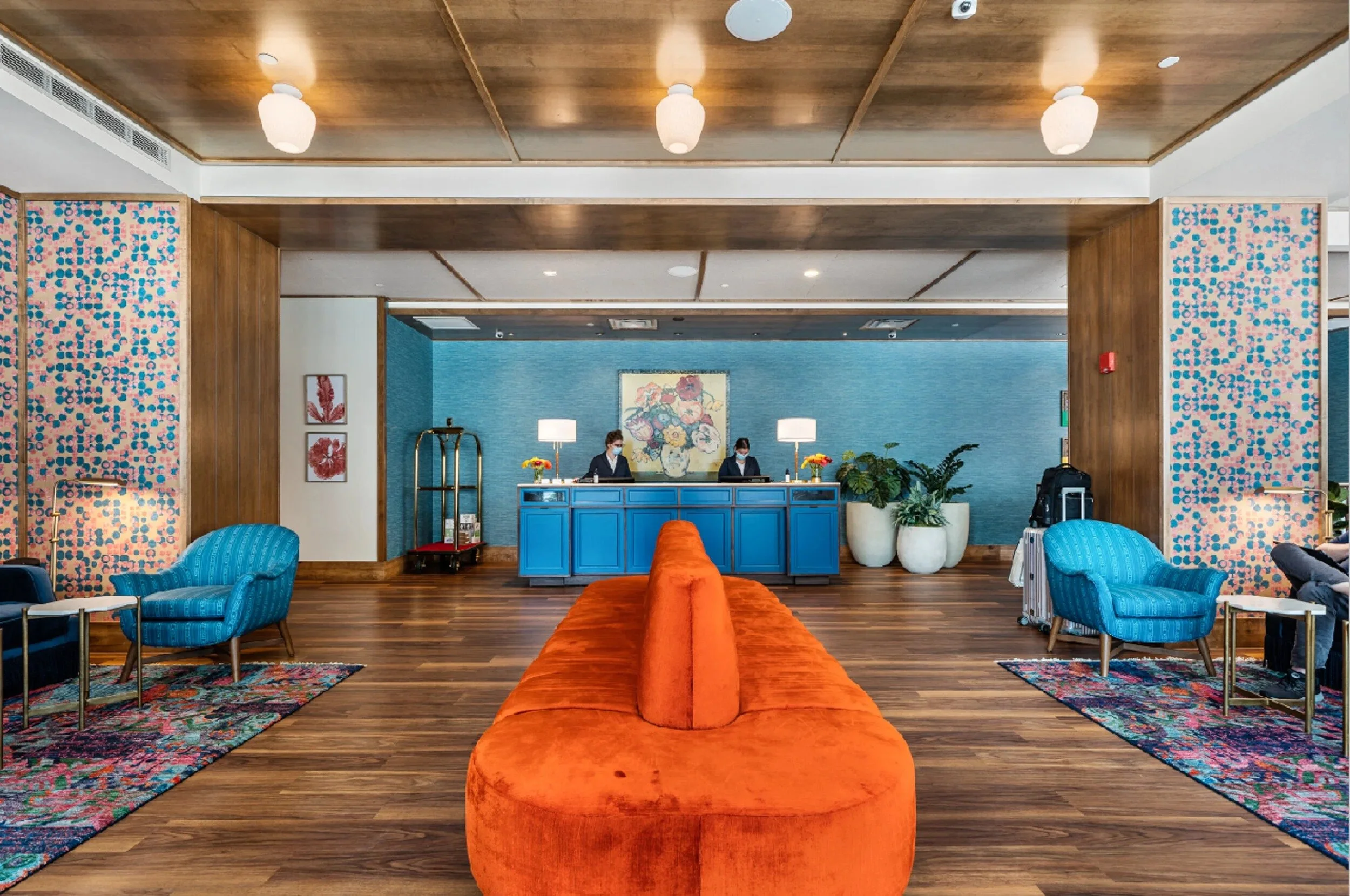
Bold colors, evocative patterns, and whimsical details. As soon as you step into the lobby your eyes are treated to a smorgasbord of bright textures and fixtures, a true candy shop for the senses. I even detected a pleasing aroma*, perfectly permeating the main floor and adding to the overall ambiance. This, is The Bradley.
Story by Laura Noggle
Bold colors, evocative patterns, and whimsical details. As soon as you step into the lobby your eyes are treated to a smorgasbord of bright textures and fixtures, a true candy shop for the senses. I even detected a pleasing aroma*, perfectly permeating the main floor and adding to the overall ambiance. This, is The Bradley.
Designed to be unique and full of local art by Barbara Bradley Baekgaard, the co-founder of Vera Bradley, and hotel developer Provenance, there is no shortage of charm or atmosphere in the city’s first boutique hotel. Although we didn’t make the grand opening, we were given a private tour that left us wanting more.
Specifically, of the two restaurants inside The Bradley, which were closed when we were there. Living downtown one gets very well acquainted with all the local spots, and a fresh face is always welcome to jazz up date night. By now it’s no surprise to those in the restaurant industry, even still, I was not expecting to learn the sole reason Arbor, the main restaurant, has not opened yet is because of a lack of staffing. Even Birdie’s, the rooftop bar has had to pare down hours for the time being.
Hyped in Architectural Digest and Veranda magazine, and touted as the lovechild of “Midwestern charm and modern design sensibilities,” it is clear in every detail that this is Baekgaard’s love letter to Fort Wayne. Warm, cozy, and fun with an upscale-at-home sensibility, it was also intended to make guests feel like family. In fact, it was intended as an extended guest house for Barb’s friends and relatives.
By highlighting local artists as well as vendors (local coffee and local beer are on the menu), The Bradley is a classy showcase of all that Fort Wayne has to offer, and is all about.
BACKGROUND
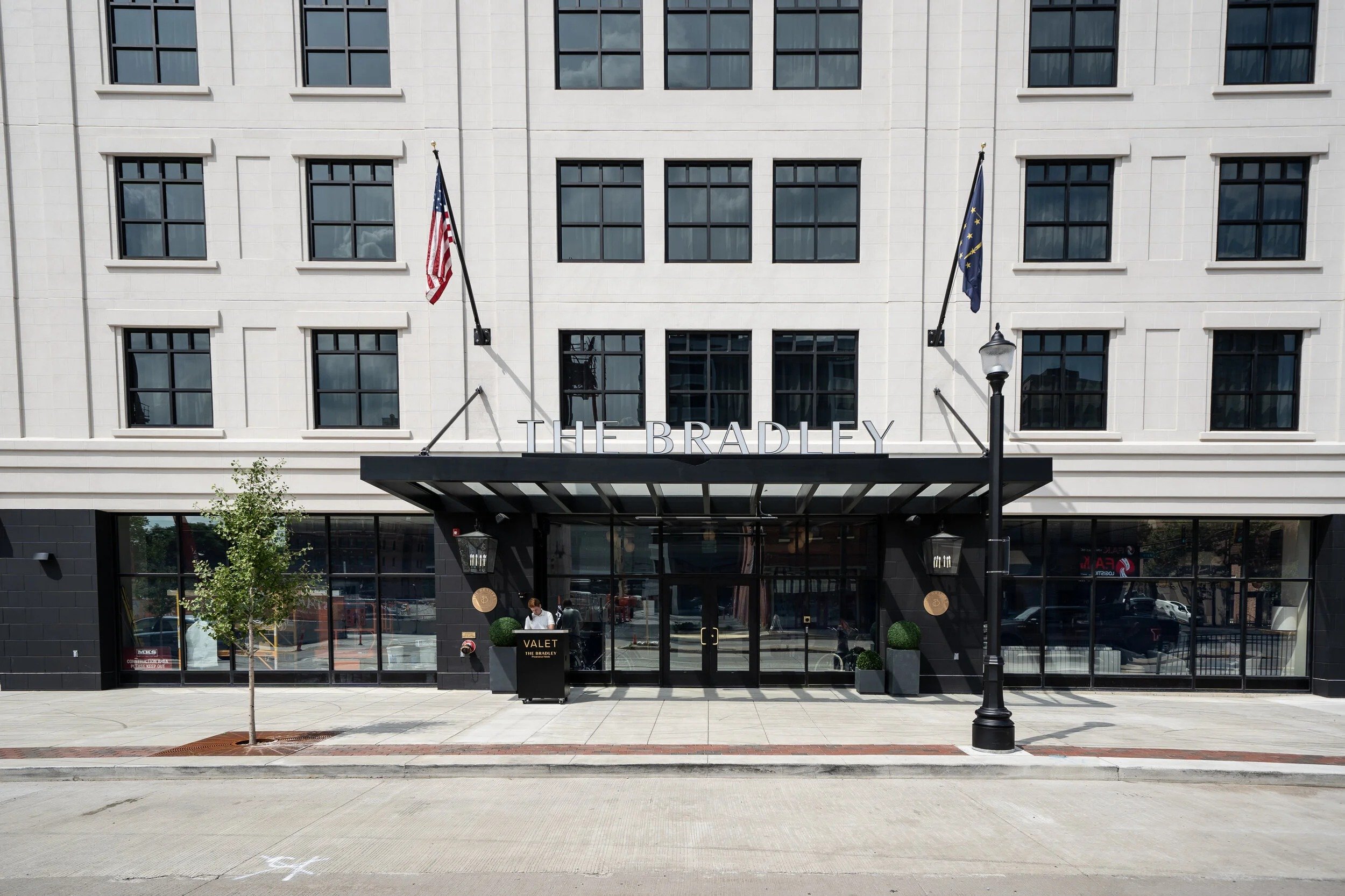
Did you know that Vera Bradley is named after Baekgaard’s mother? And her first full-service hotel is an homage to her salesman father, who was frequently on the road. Not only did Baekgaard pick up on her father’s business gifts, she also fell in love with hotels.
Traveling the world for work, it became Baekgaard’s dream to design her own hotel some day with polished, curated aesthetics. After retiring in 2017, it was time to pursue her idea for The Bradley. Construction of the $30 million hotel began in May 2019, and the rest is history.
“I’ve lived in Fort Wayne now for over 40 years and we were just missing that element of the city and I didn’t think there was anything that really represented who we were.”
ART
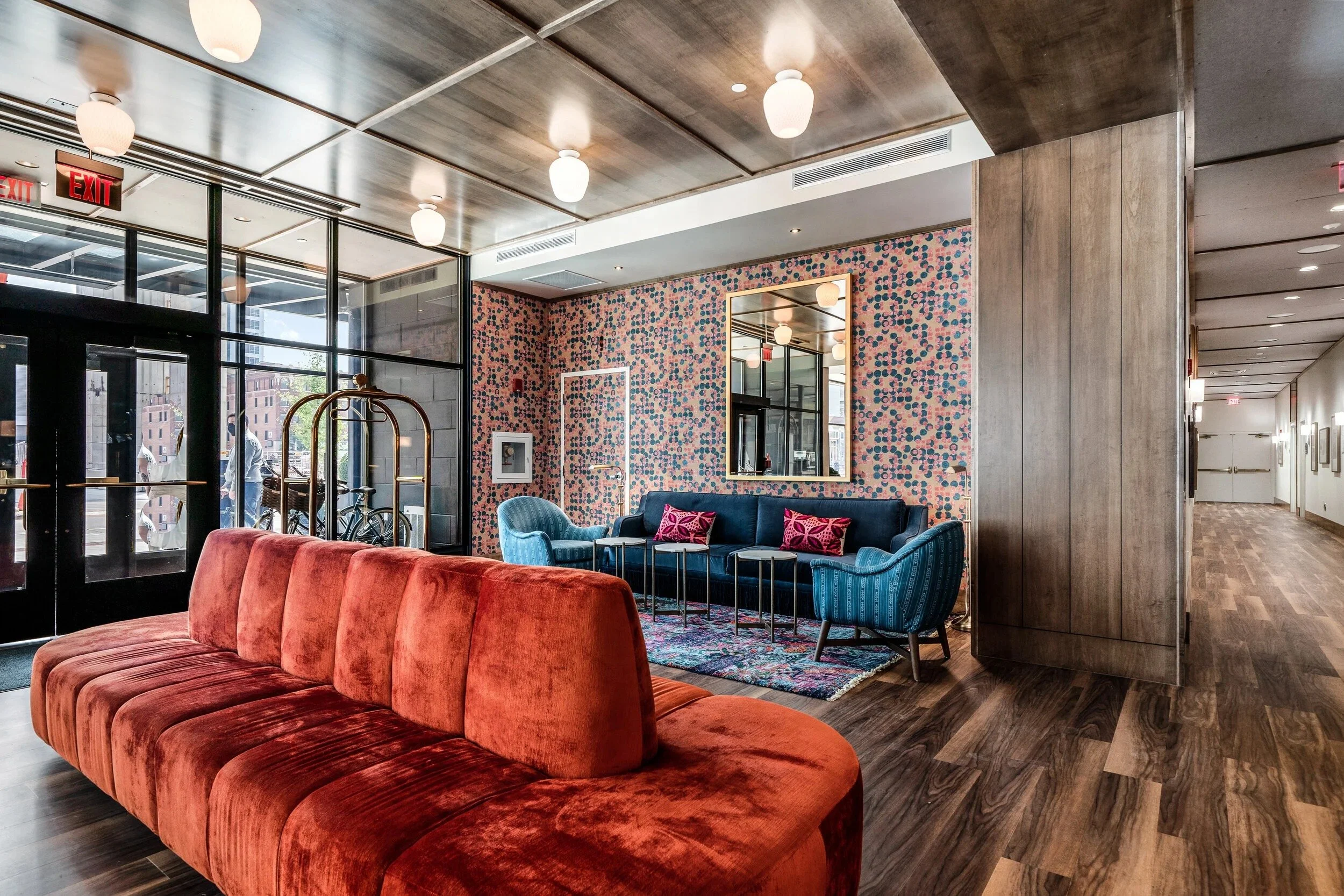
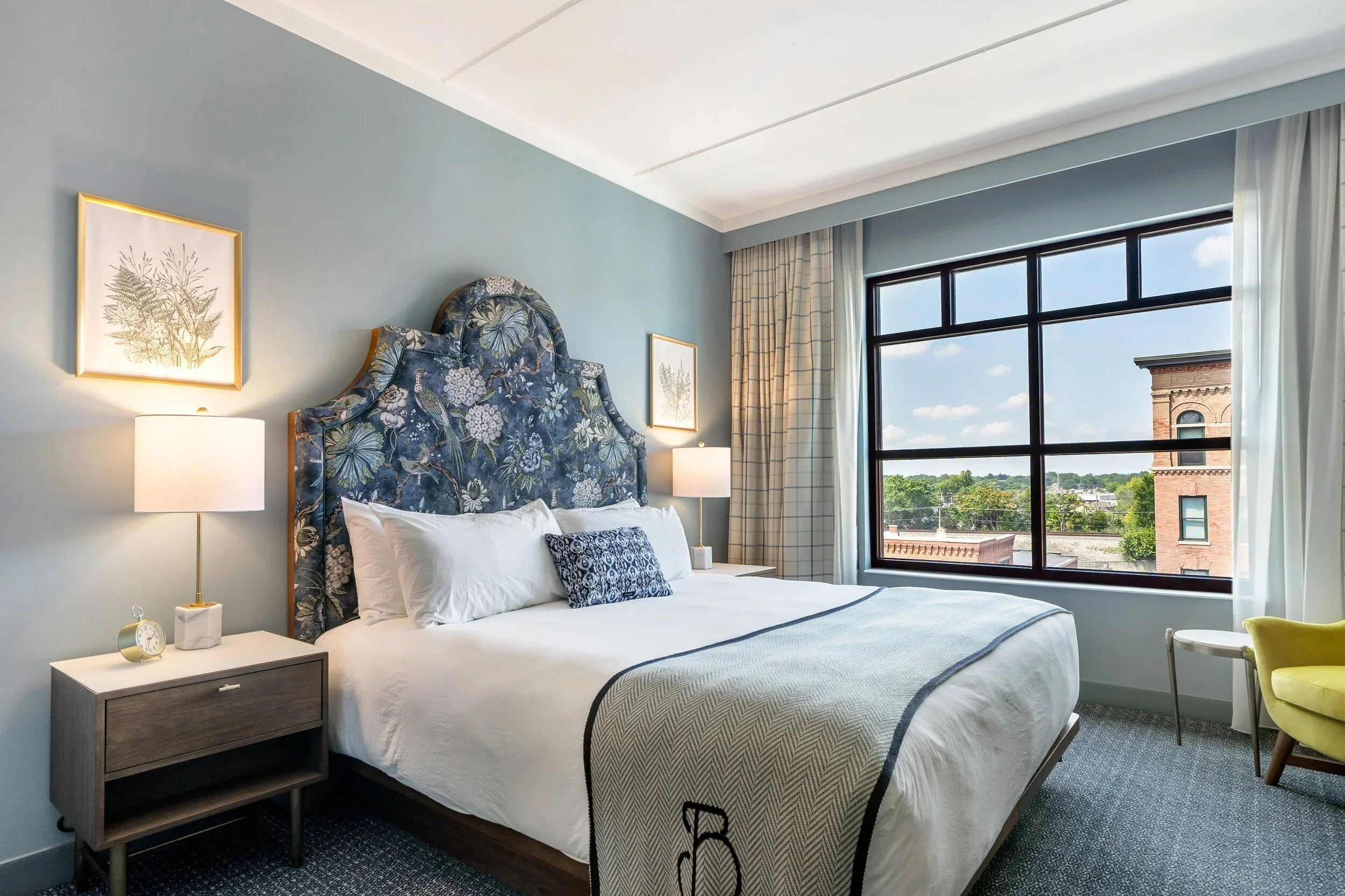
The undeniably eclectic air is complemented by standout local talent. Theoplis Smith III, aka Phresh Laundry, is featured throughout the hotel most notably in the lobby and private dining room, with half dipped paintings that are especially eye catching. Julie Wall of the HEDGE studios created custom letterpress prints of Fort Wayne botanicals that flank the beds in each guest room.
A curated, on-site gallery hosted in partnership with the Purdue University Fort Wayne Department of Art and Design showcases themed, semi-annual exhibitions from students, alumni, and faculty. The inaugural installation focuses on photography, with the individual works and artists listed online. Like what you see? All pieces are also available for purchase.
STYLE
You might expect an abundance of Vera Bradley products inside, but you’d be hard pressed to find much aside from an occasional throw pillow and one merchandise cabinet. What is for sale is quite memorable and special too. The women’s restroom has custom-designed wallpaper with peonies (state flower), cardinals (state bird), and the Fort Wayne skyline. This one-of-a-kind pattern can be found on items exclusively for sale in the hotel gift shop.
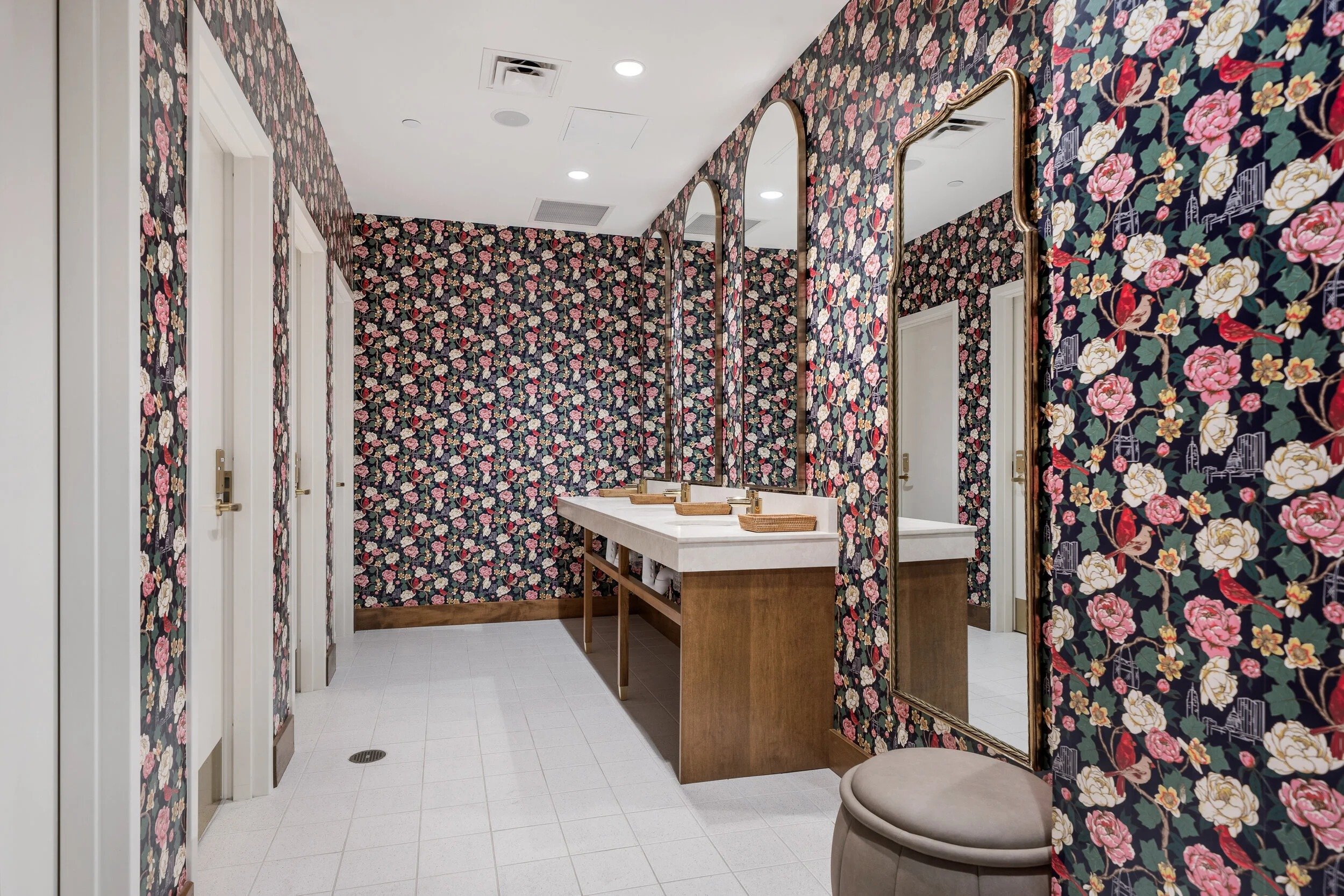
Not to be outdone, the men’s restroom wallpaper features bespoke canes, a tribute to Baekgaard’s late husband who always collected canes on trips.
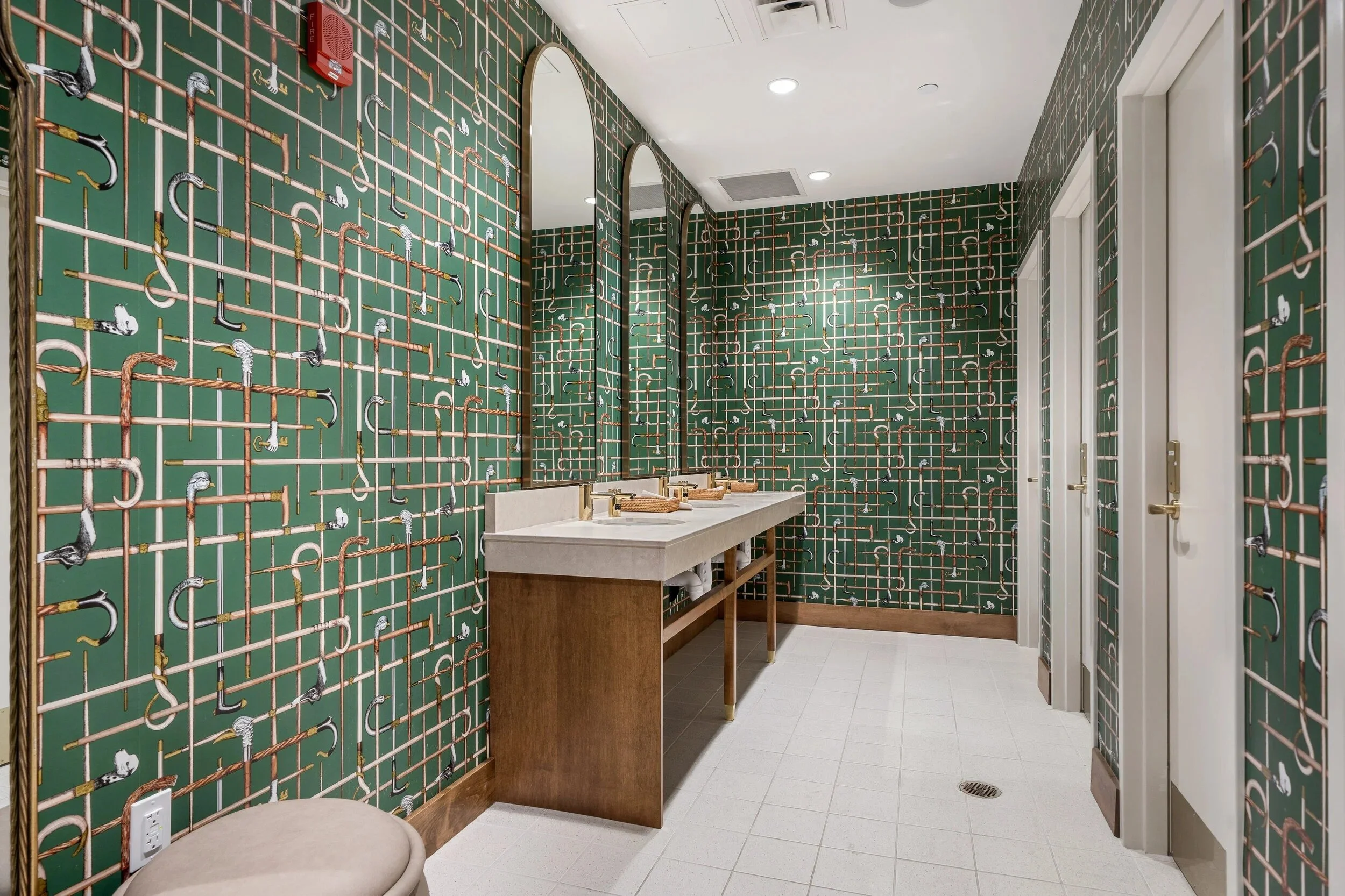
Still, Baekgaard’s hallmark touch is evident not only through the cheerful patterned wallpaper, but also through the vibrant artwork, fresh flowers, and friendly staff.
FOOD
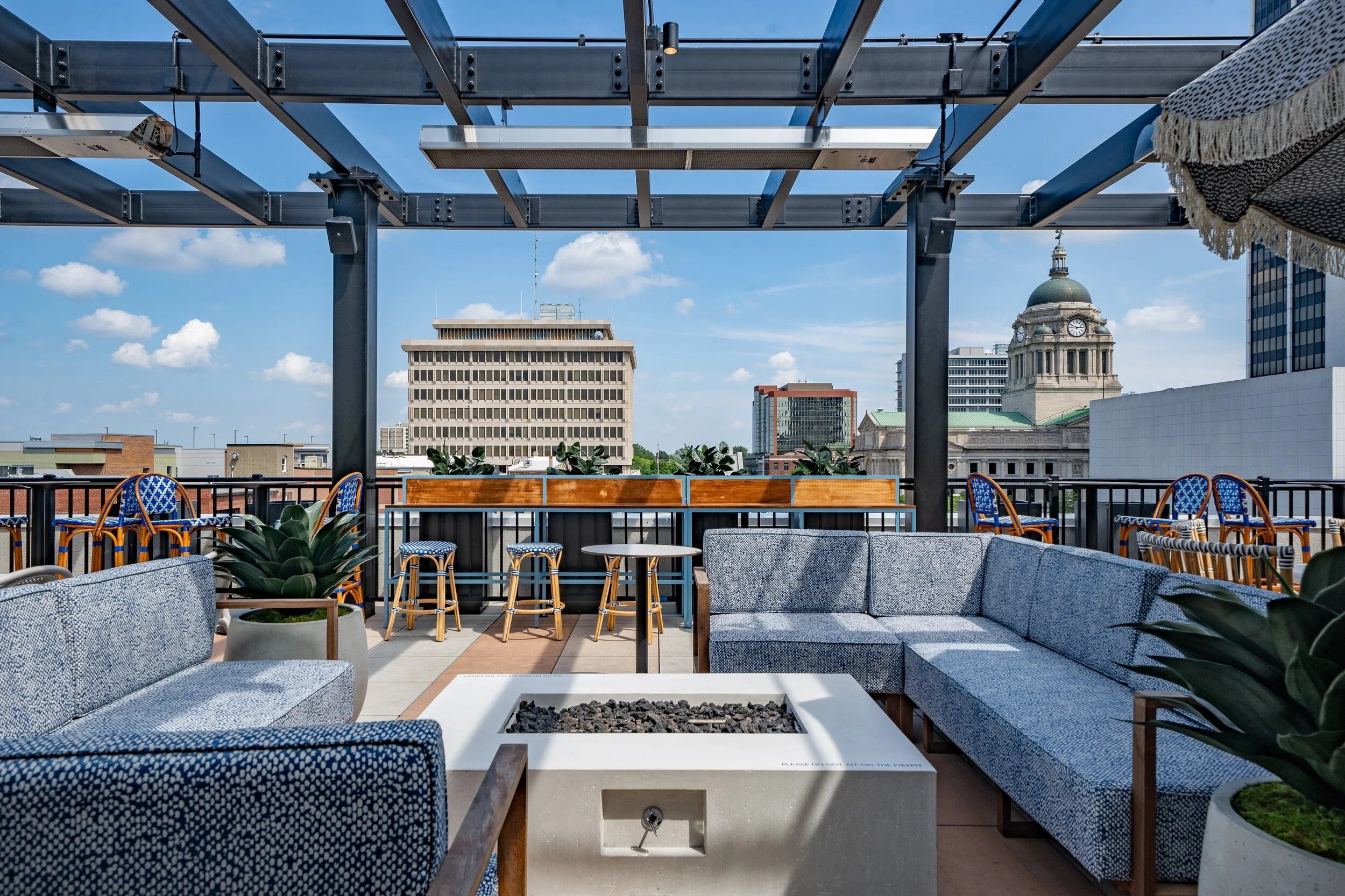
Let’s start with Birdie’s where you can get small plates, classic cocktails and impeccable downtown views. Walking into this 5th floor rooftop restaurant with both indoor and outdoor seating, I was immediately reminded of the 1996 movie, The Birdcage. It is impossible not to feel the spicy flavors of Ocean Drive in this magical space.
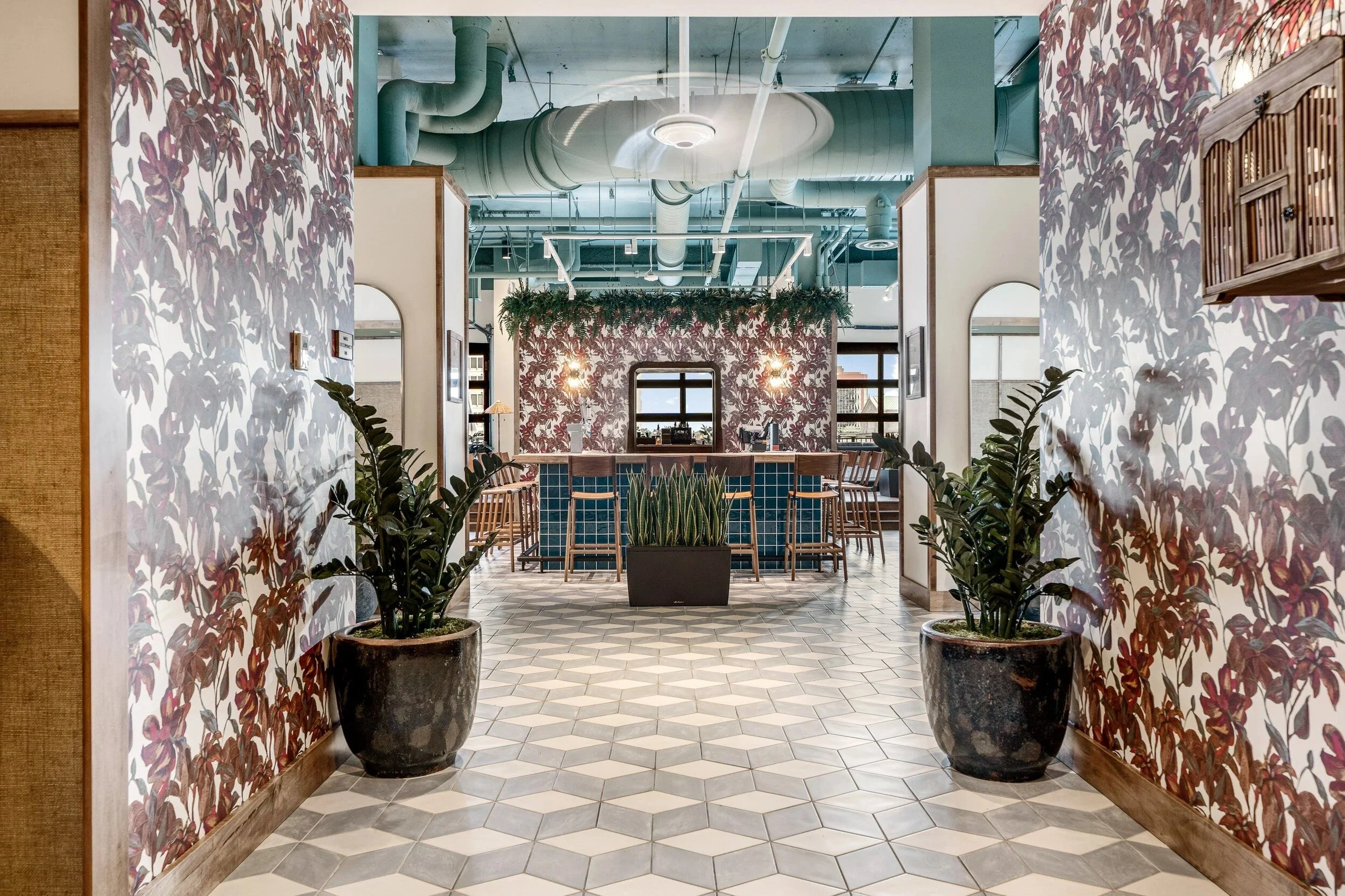
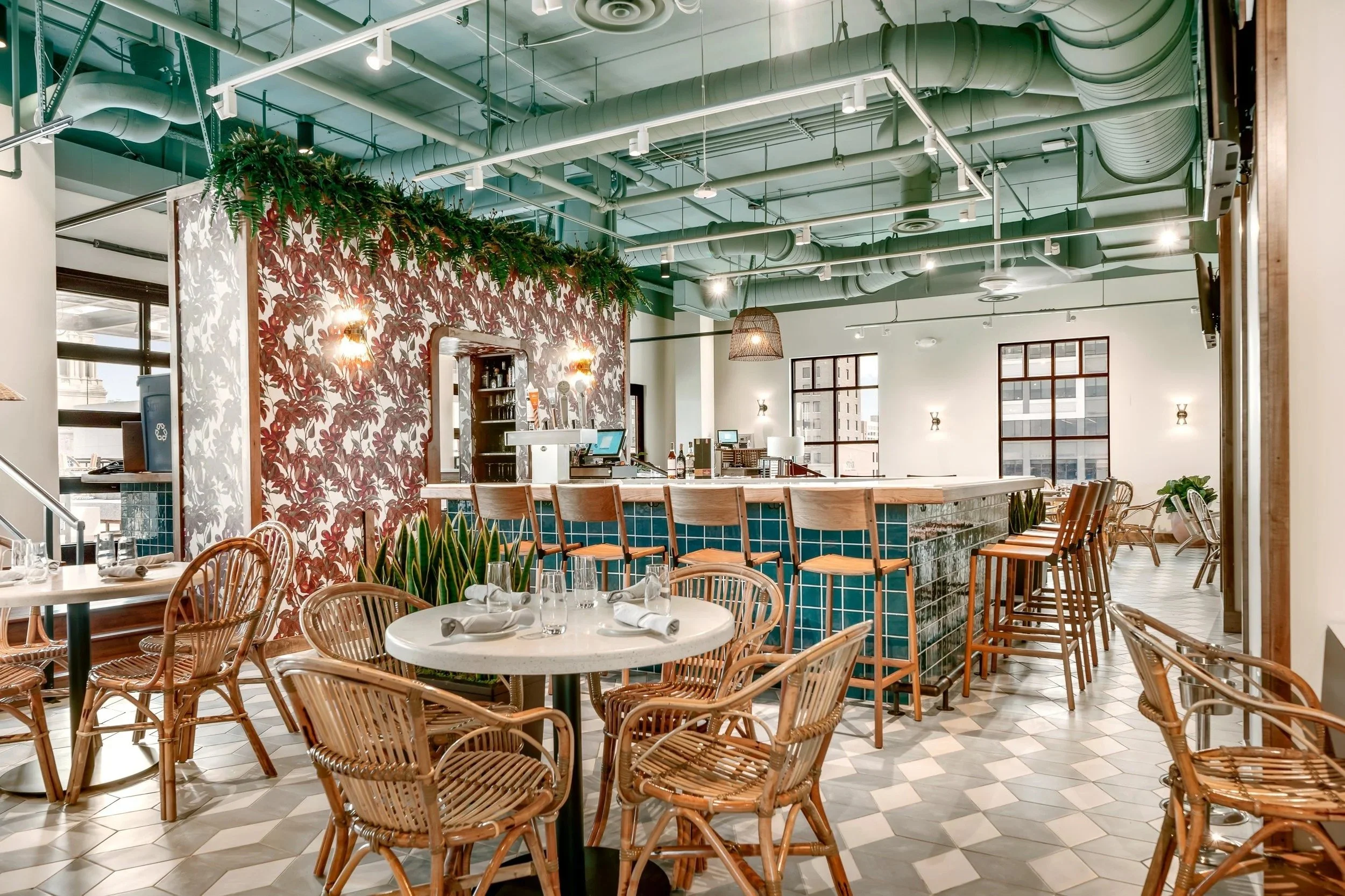
Growing up in Miami Beach, Barbara was surrounded by Art Deco palaces and the Floridian inspiration comes through in spades. The name also hits close to home as Baekgaard’s grandchildren call her Birdie … because of her fondness for birds.
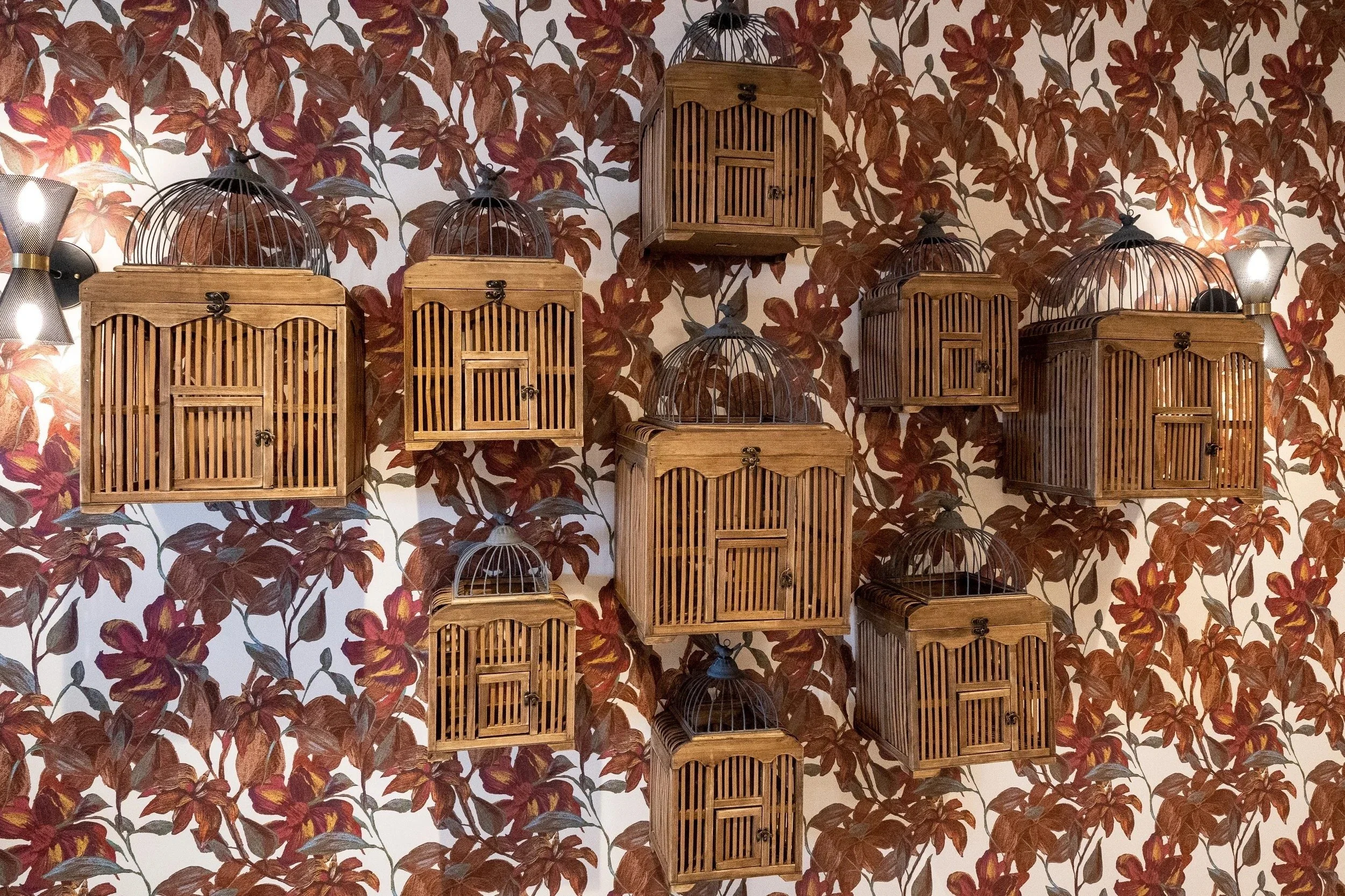
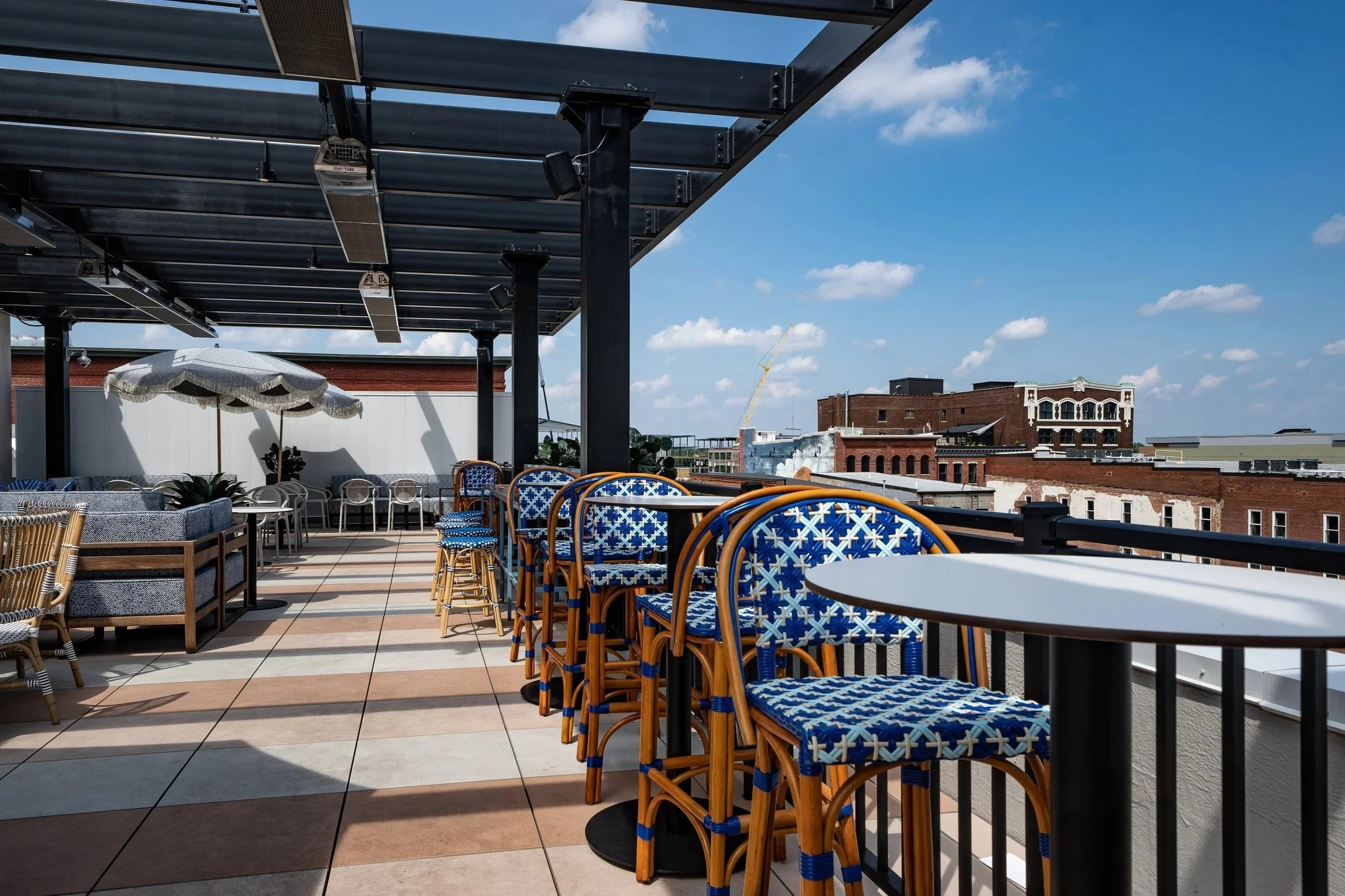
Rattan birdcages line the entry, tropical wallpaper pops, and big garage doors to the outdoor patio allow the restaurant to transport you to another realm, or at the very least, spark a lighthearted joie de vivre. The open air portion has heaters and a fire pit for colder temperatures. Currently, Birdie’s is open Tuesday through Saturday, 5-10 pm, but be sure to make a reservation as the bar is the only place that accepts walk-ins.
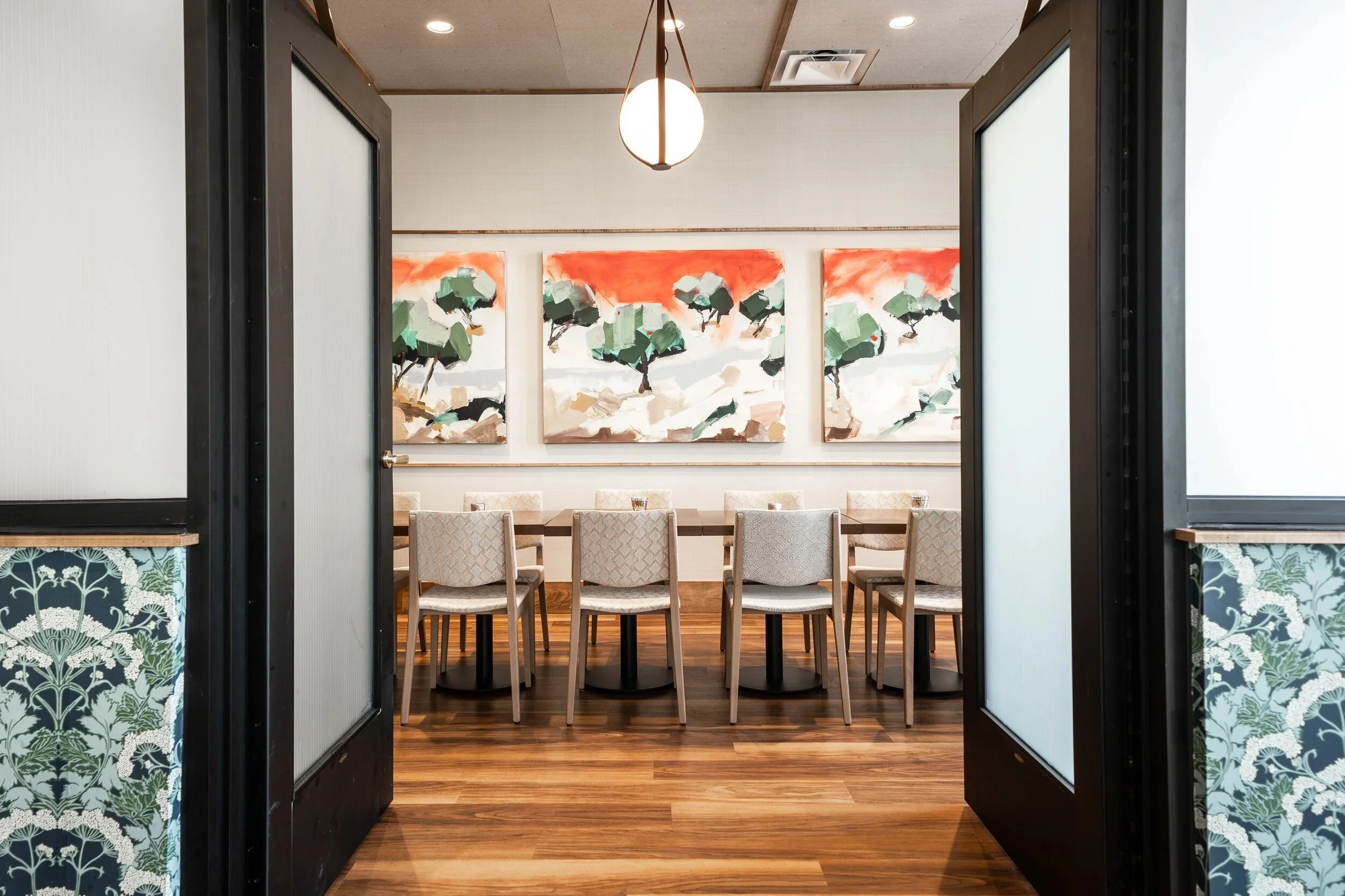
Arbor, the all-day restaurant (eventually) is located on the ground-level. The name is rooted in the city’s treelined trails and parks, with locally-sourced ingredients on the menu—think comfort food with an elevated twist. A private dining room is available as well as a seasonal patio. Although it’s not currently open for lunch or dinner, you can still get Utopian Coffee and breakfast from 6:30 to 11 am.
REST
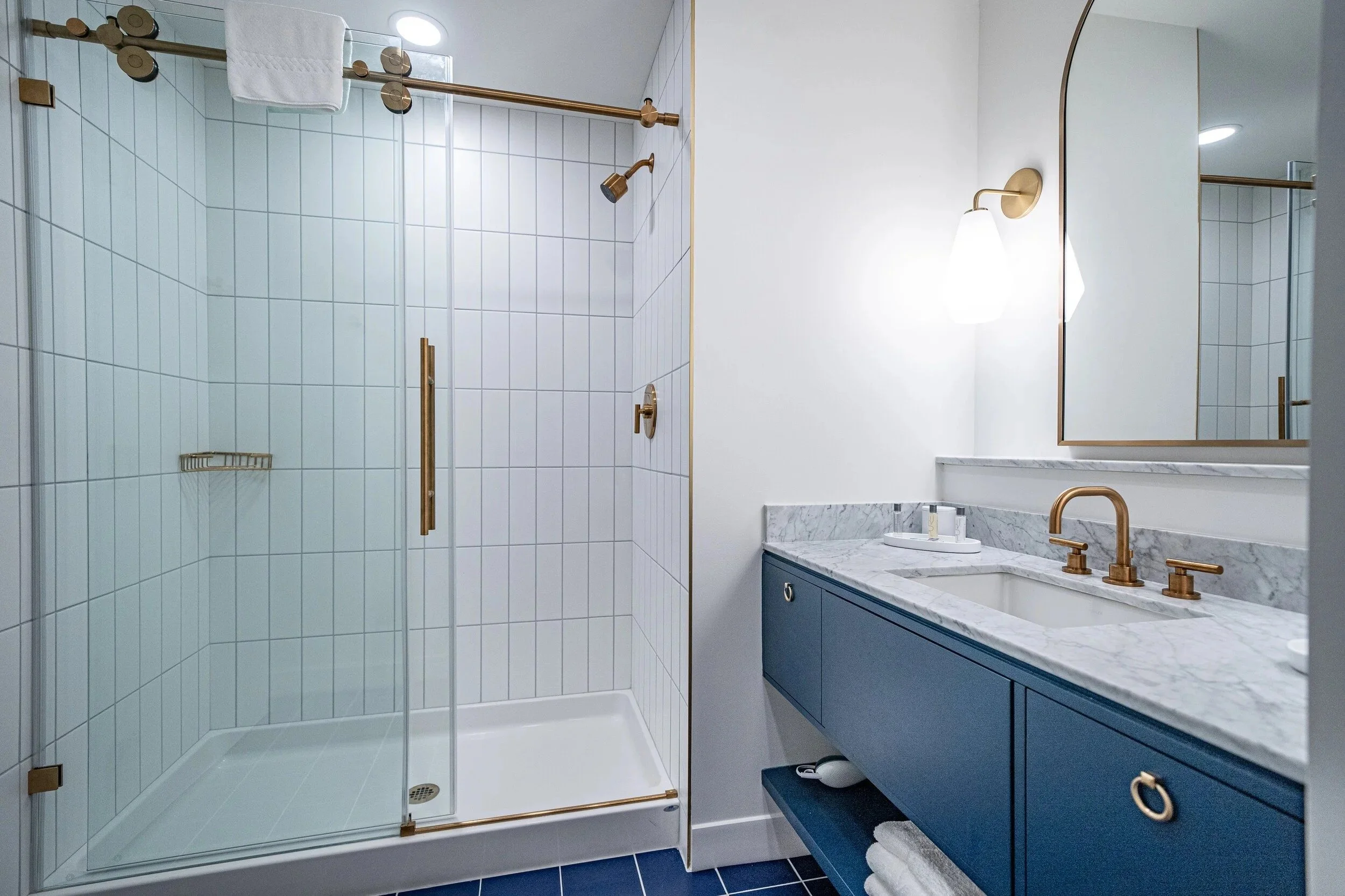
There are 124 rooms and nine suites in this luxurious, art-centric hotel and it is part of the larger Provenance family with swanky, glamorous hotels across the country. Each of the suites are named after an Indiana city and decorated with different themes.
Amenities listed on the website include “Accredited Cleaning”, “Sleep Experience”, “Spiritual Menu”, “Virtual Concierge”, “Well + Fit”, and did we mention The Bradley is pet friendly!?
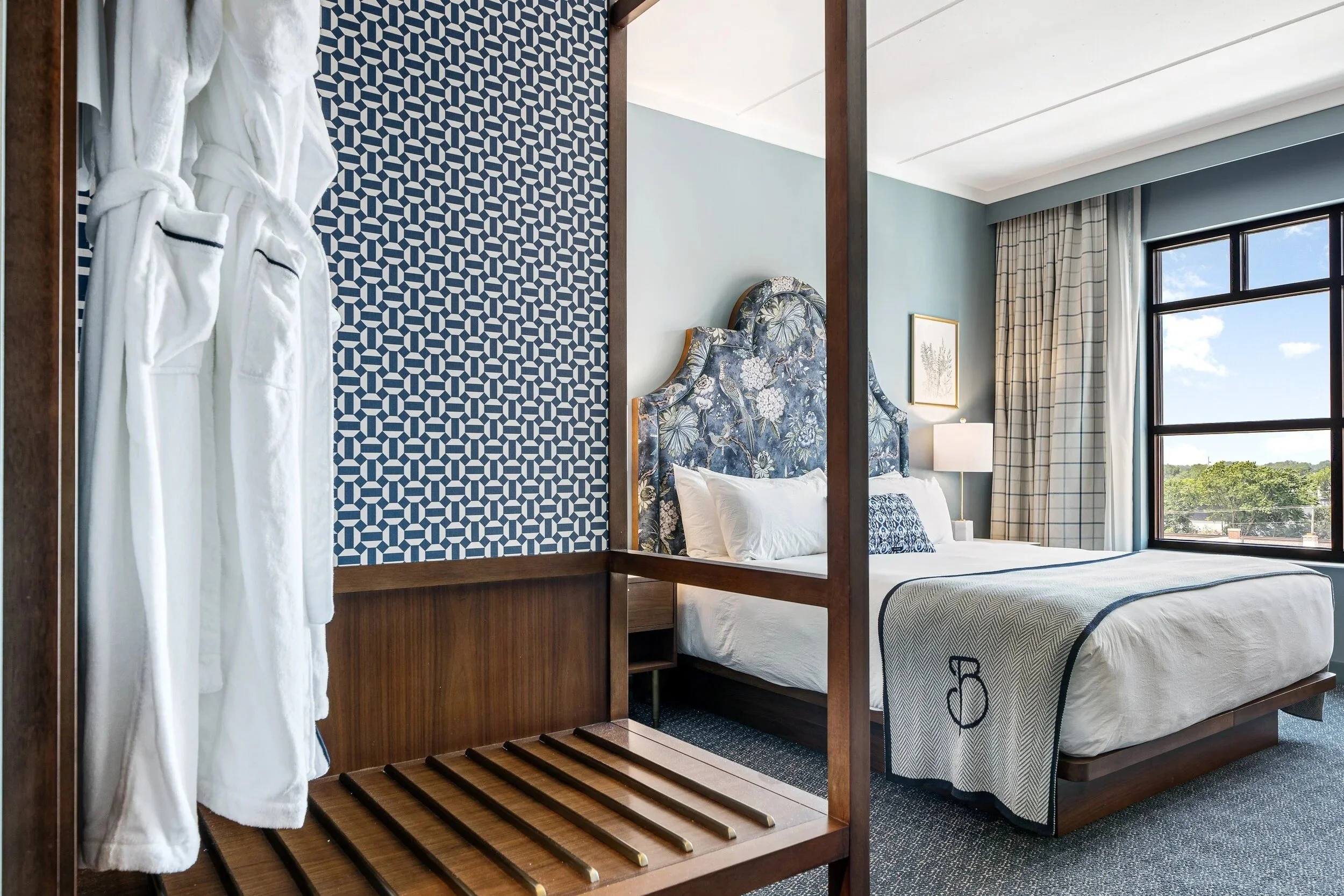
“I wanted something that when people were in here, they felt they knew where they were in Fort Wayne and then when they leave, they have a memory of Fort Wayne. That was one of my goals.”
To be honest, I got serious Wes Anderson meets Willy Wonka vibes from The Bradley and I am absolutely here for it. It’s revitalizing to know that whimsey, art, and creativity are alive and well in downtown Fort Wayne.
*In case you’re still curious, as I was about the evenly distributed perfume … our guide didn’t know the scent or the source but apparently I’m not the only one who has asked about it. A mystery for future investigation.
_______________
Photography by Tony Frantz
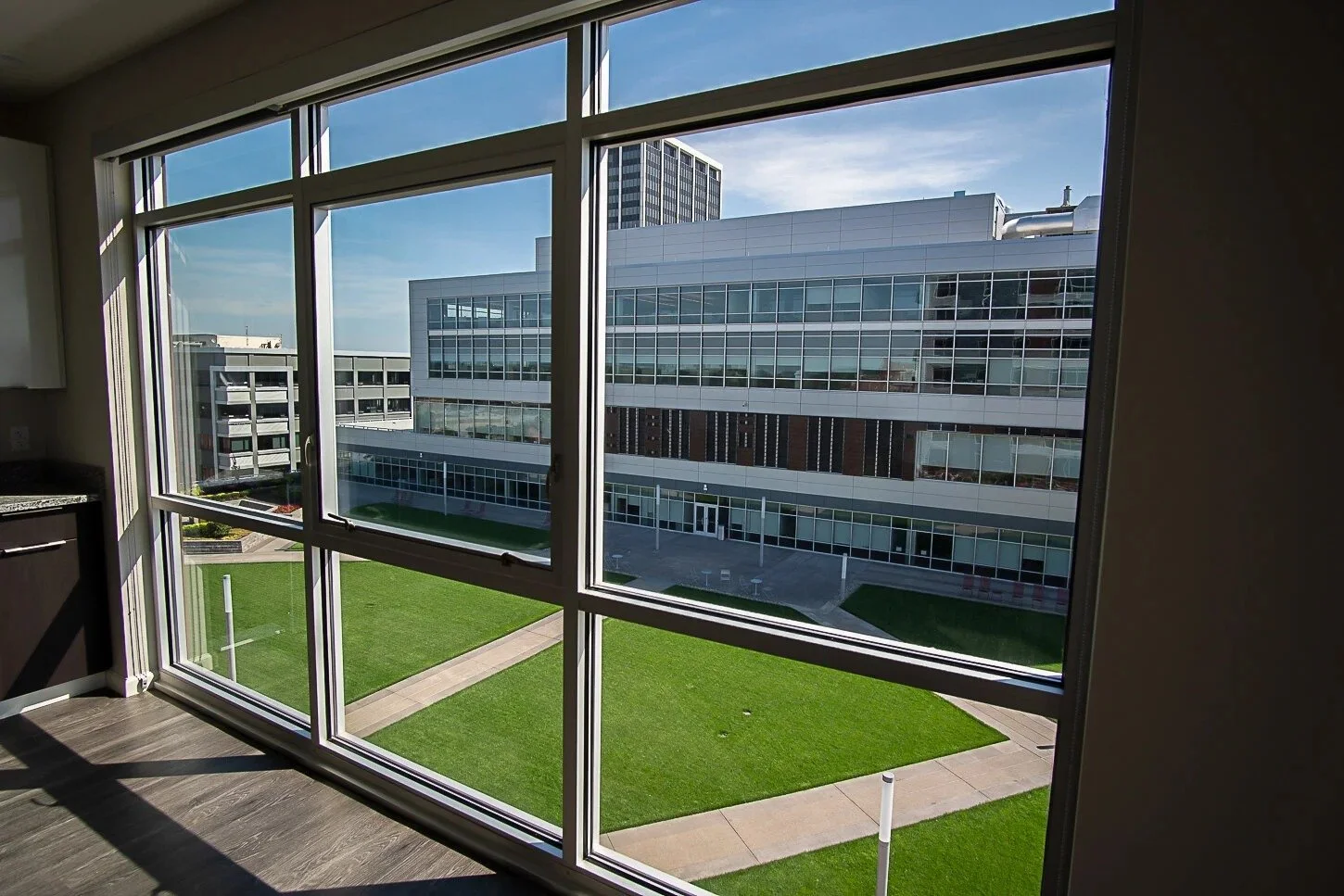
Downtown Living in the Fort
The downtown population is growing, thanks to several new and exciting living options in the 46802. Here is a quick overview of the most recent communities bringing more life, vibrance, and activity to the downtown area.
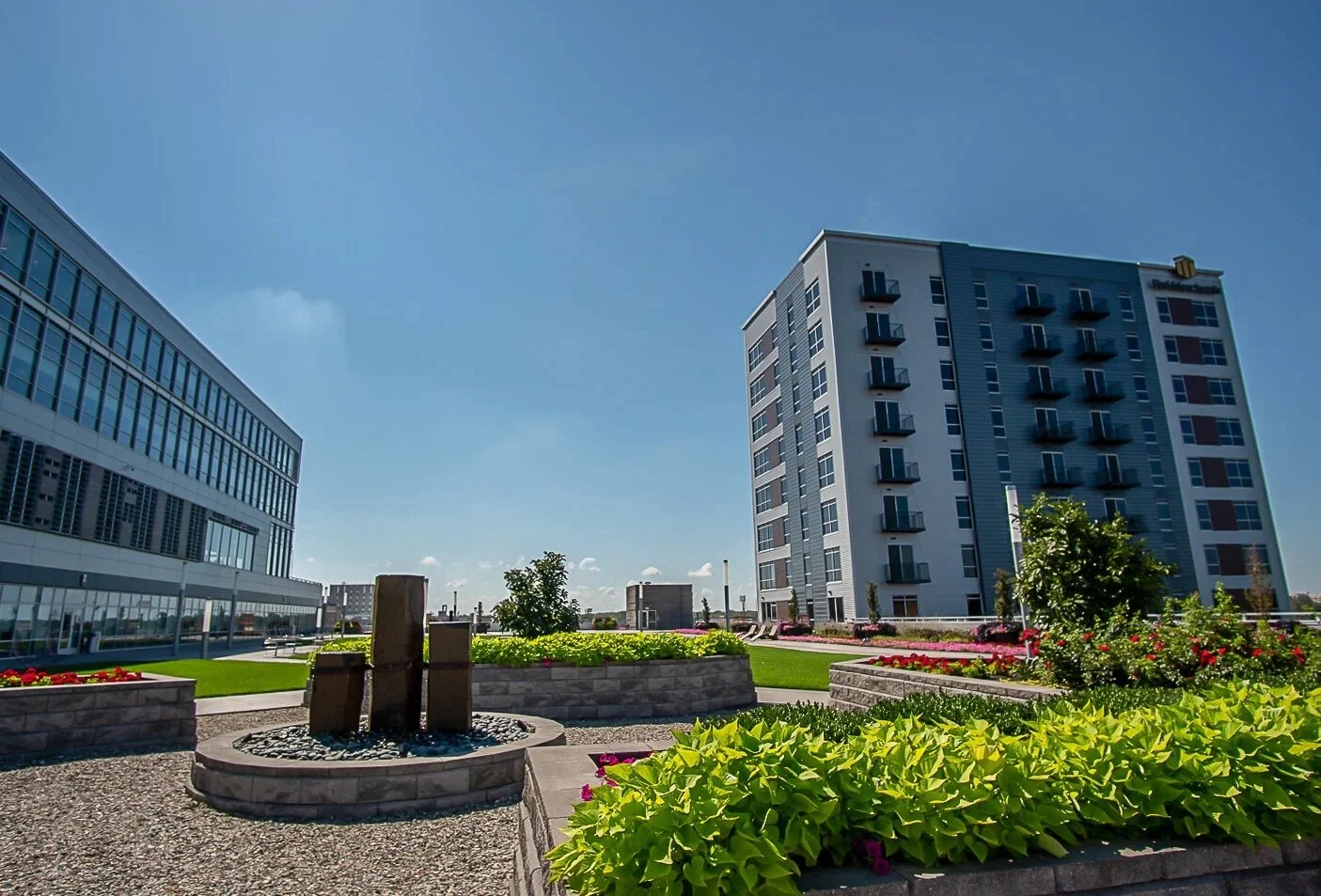
View of Skyline tower from the green space on top of the parking garage (Tony Frantz)
The downtown population is growing, thanks to several new and exciting living options in the 46802. Here is a quick overview of the most recent communities bringing more life, vibrance, and activity to the downtown area.
View from inside Skyline Tower
Skyline Tower
Official Opening: August 2018
Units: 122
Floors: 3rd-12th
Parking: Attached, 5 stories 1,200 space Skyline Garage (190 reserved for tenants)
Pet Friendly: Yes, 2 max. 50 lbs, no aggressive breeds. $300 upfront (half refundable), $30 per month
Price: 568 sqft studio starting at $758 // 1336 sqft 3 bed/3 bath starting at $2100
Attached to the Ash Brokerage building, this one is hard to miss. The twelve-story luxury apartment building sits on top of Ruth’s Chris (1st floor) and the regional headquarters of First Merchants Bank (2nd floor), clocking in as the seventh tallest building in Fort Wayne.
Residents have access to a unique green space located on the 6th floor of the parking garage. This 40,000 sqft private courtyard—believed to be the largest elevated green space in Indiana—overlooks downtown and features beautiful landscaping, walking paths, and seating areas.
With epic views of the city from a modern aesthetic, Skyline Tower provides urban living without the cost and hassles of a big city.
Features: New construction, floor-to-ceiling windows, relaxed balconies and patios, doggy pad, grill stations, club room, access to one-acre green space, street level retail, incentive program for lower rent.
Superior Lofts
Official Opening: November 2018
Units: 72
Floors: 2nd-4th
Parking: Lot behind, and bus depot across the street (100+ spaces in new complex yet to be completed)
Pet-Friendly: Yes. 75 lbs max, $350 upfront (non refundable), $25 per month
Price: 1 bedroom 747 sqft starting at $925 // 2 bedroom/1 bath 1028 sqft starting at $1525
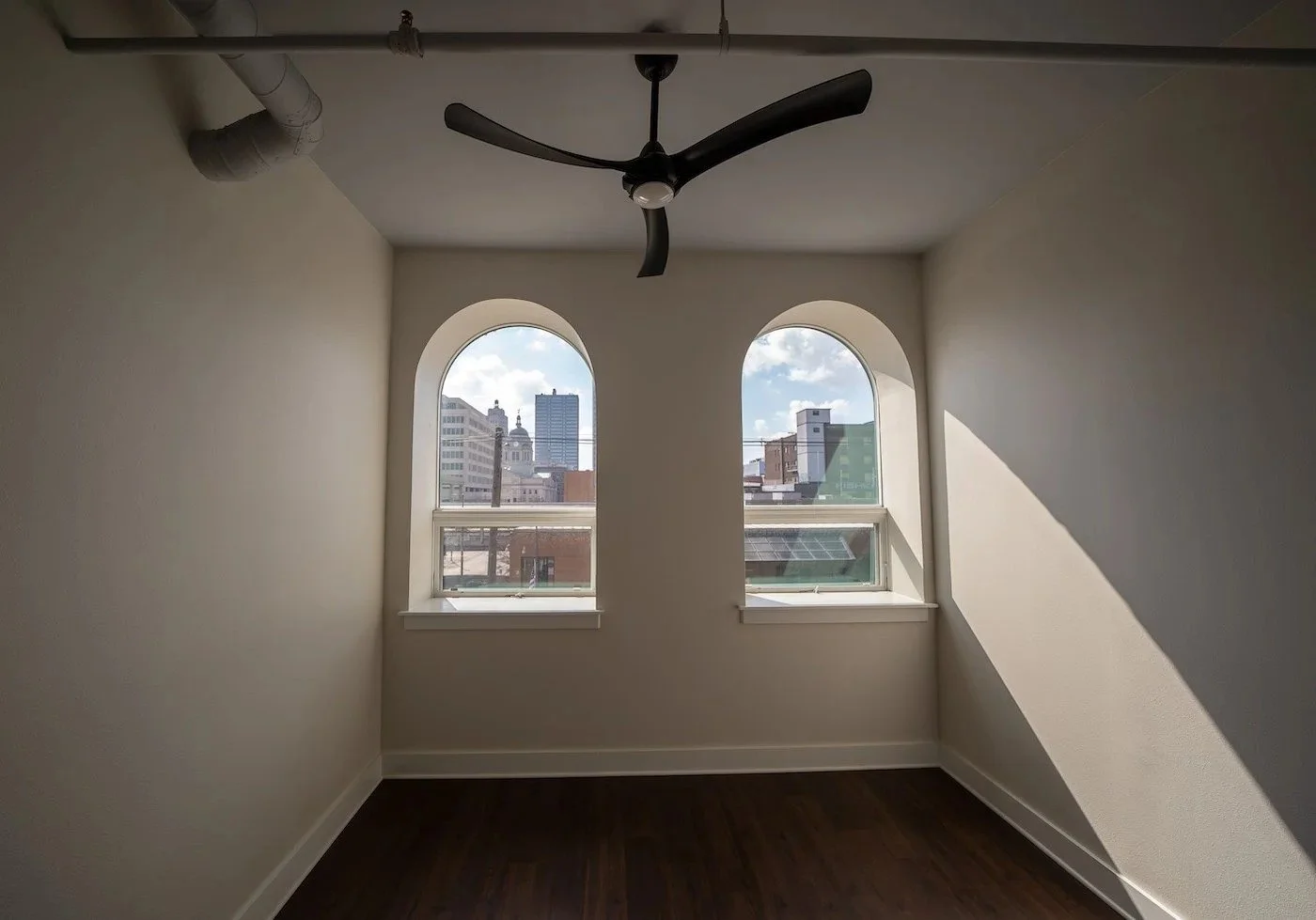
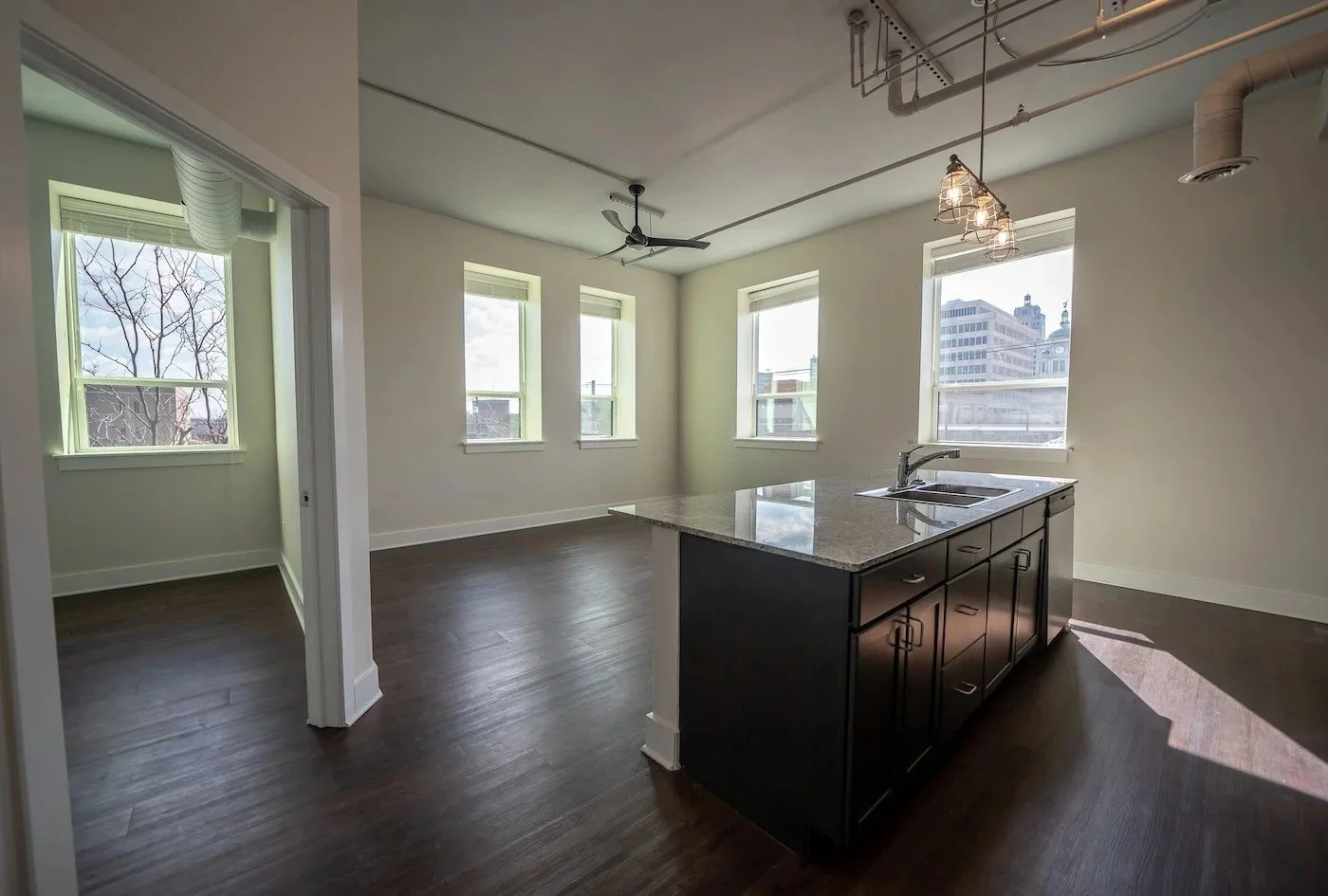
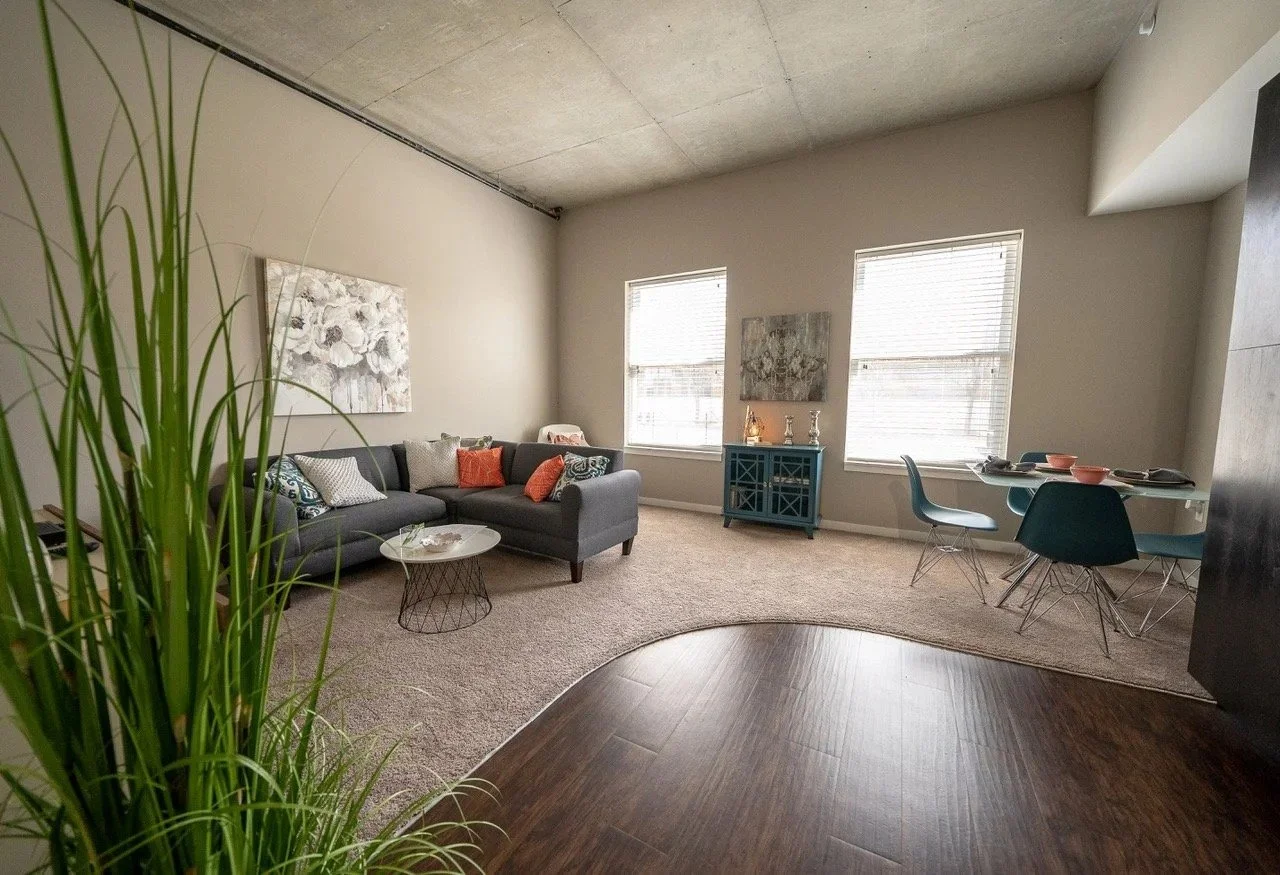
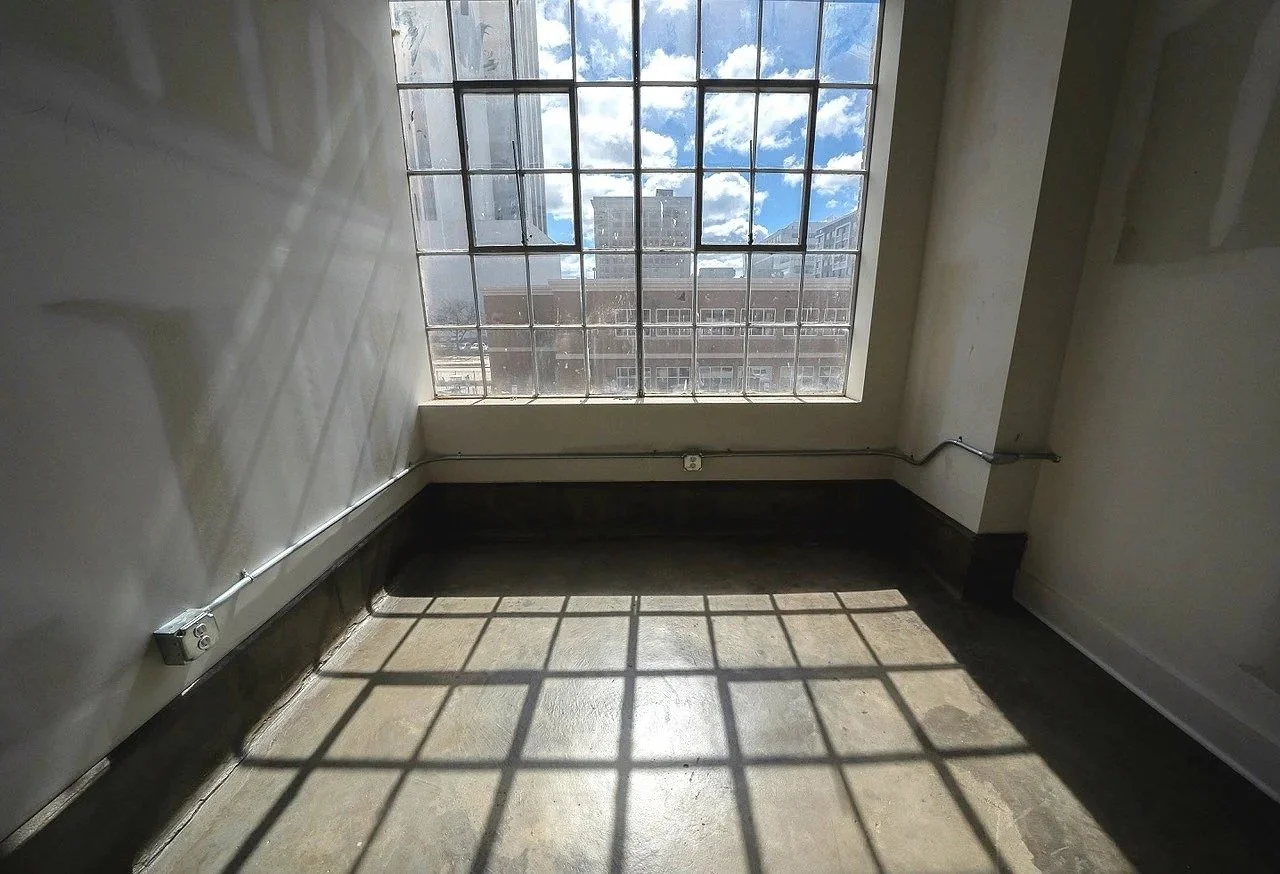
Located in the former Graphic Packaging facility on West Superior Street these high-end, modern loft-style apartments feature 14 different floor plans. Built in 1905, this restored industrial building had been vacant since 2010.
Constructed in the Art Moderne architecture design the building’s industrial past is reflected in the large windows, high ceilings, columns, and concrete floors.
The developer, RealAmerica also developed Randall Lofts on Harrison Street, which opened in 2014.
Features: Historical renovation, exposed beams, fitness room, community room, StorAmerica (climate-controlled self-storage) available in basement, close to Headwaters Park and the new Riverfront District.
CityScape Flats
Official Opening: May 2017
Units: 163
Floors: 3 and 4-story buildings
Parking: Attached, covered parking garage, one space per apartment
Pet Friendly: Yes, 2 max. No weight limit just breed restriction. $250 registration fee, $25 per pet monthly.
Price: 522 sqft microstudio starting at $875 // 2 bed/2 bath starting at $1802
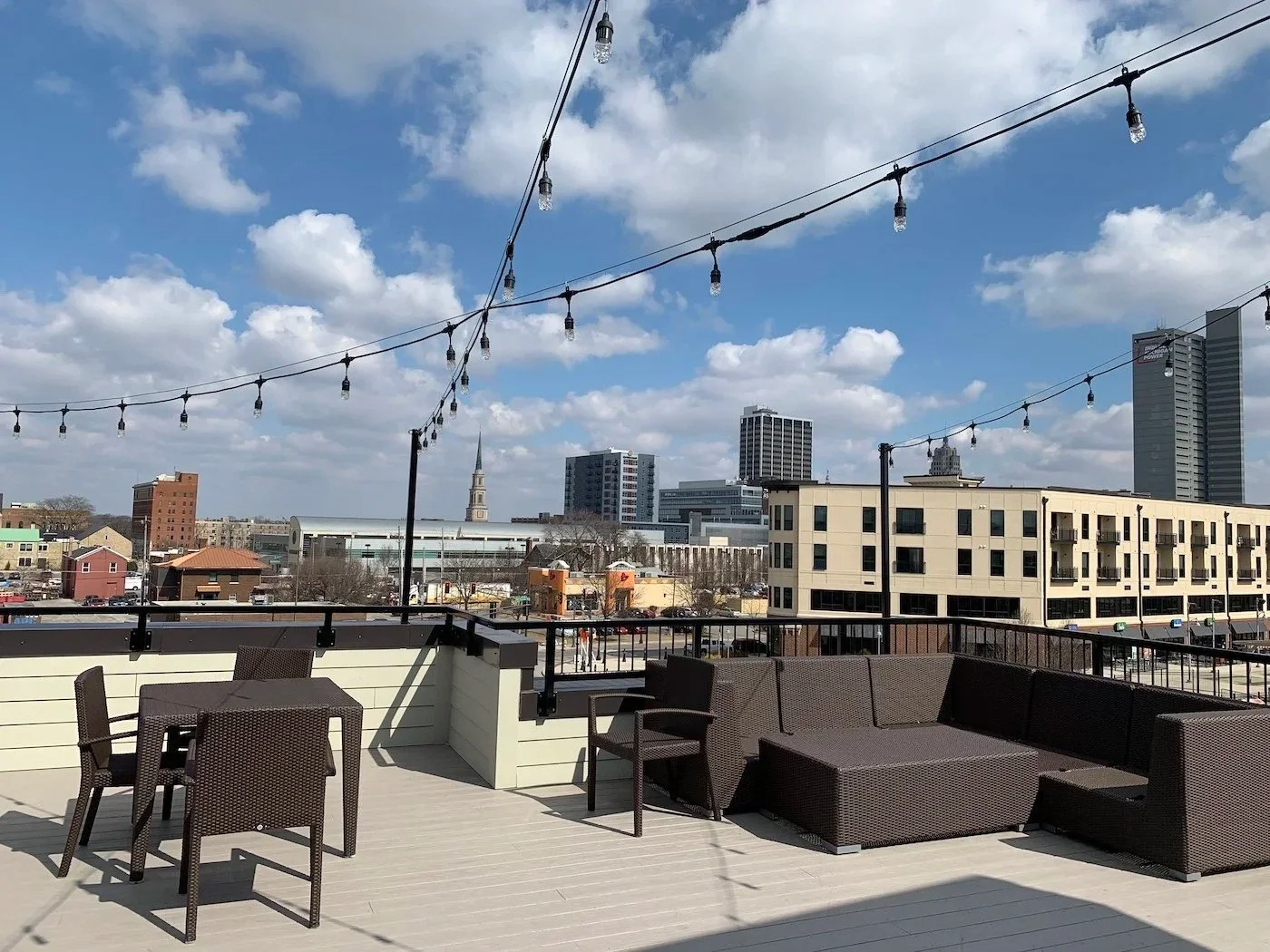
Located next to Parkview Field between Ewing Street and Fairfield Avenue, CityScape is the ideal dog-friendly community with a private one-acre green space built on top of the parking garage. Synthetic turf grass means it’s green year-round, providing fresh views of the courtyard.
Nine floor plans with views of the baseball diamond make this luxury apartment complex perfect for hardcore fans and those seeking a dynamic place to live.
Features: New construction, dog park and 24-hour pet wash area, grilling patio, reflecting aqua bench (/wading pool), club room with rooftop patio, fitness center, large outdoor private patios
CityScape Townhouses
Units: 5 available at the time of writing
Floors: 3 and 4-story units
Parking: Attached 2 car garage
Price: 3 floor plan options, 2-3 bedrooms/2.5-3.5 bathrooms starting at 1674 sqft and $371,000
The luxury Townhouses at CityScape Flats are entirely customizable with a range of décor options and the opportunity to work one-on-one with a designer. Cityscape Townhouses are “built for cocktail-sipping, baseball-loving, boutique-shopping, riverfront-exploring urbanites.”
Three of the 14 townhouses were sold within the first week they went on the market in late 2016.
Features: New construction, access to all CityScape amenities, and either a rooftop garden patio or two breakfast balconets
Contact Beth Goldsmith (beth@soldbythegold.com) or Lynette Johnson (lynette@soldbythegold.com) for more information.
Coming Soon …
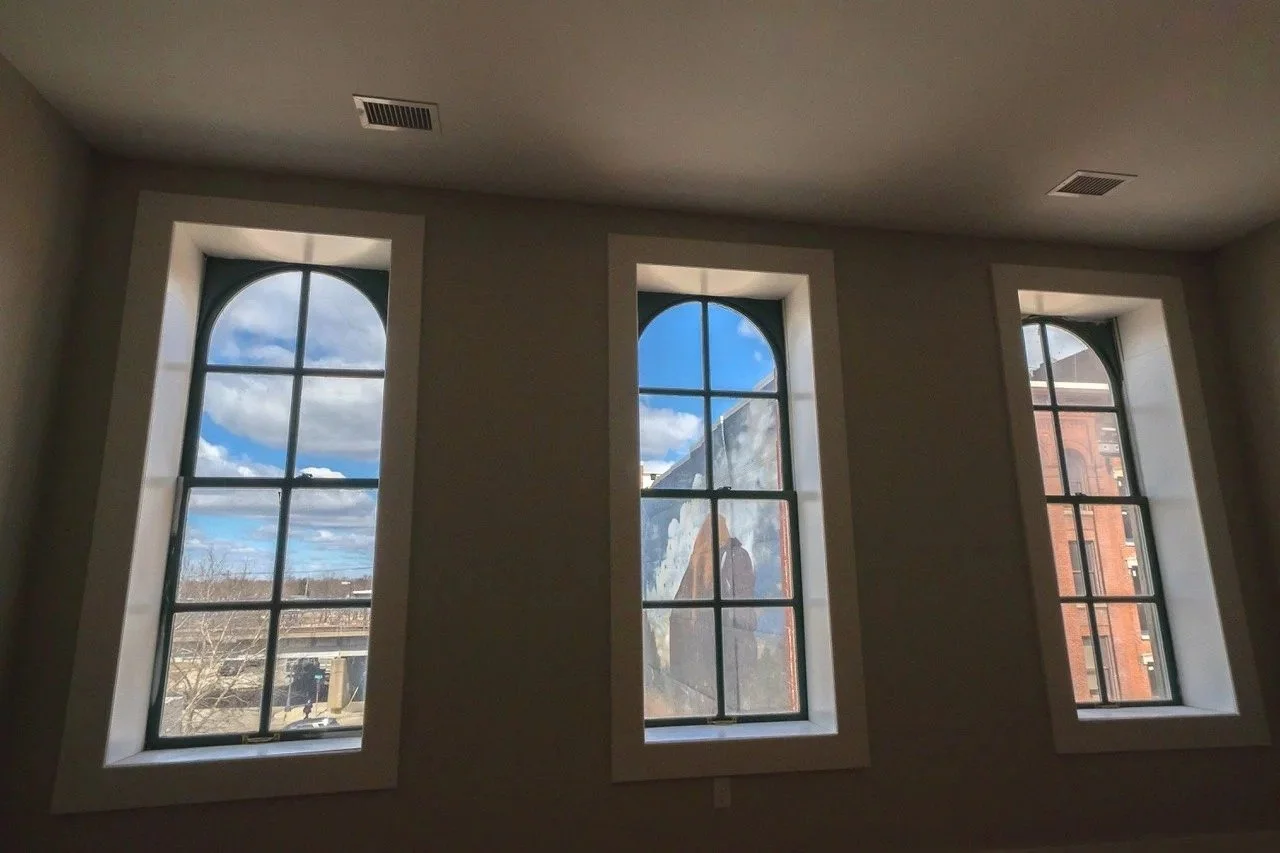
Apartments on The Landing
Status: Under construction, est. completion 3rd quarter 2019
Units: 70
Floors: 2nd-6th
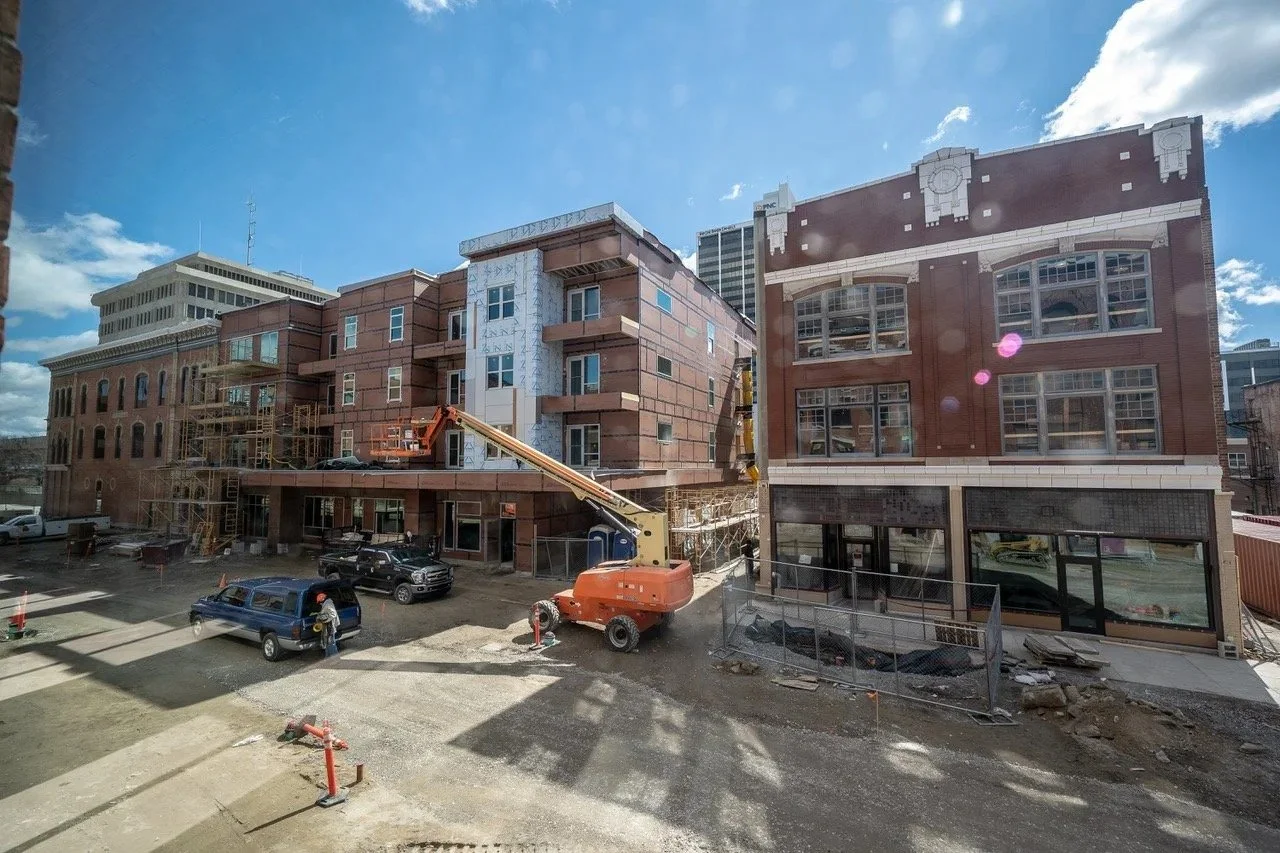
The Model Group began construction on the mixed-use $32.2 million project in February 2018. Development of the historic block on West Columbia Street is more than just new residential and commercial space, it includes the historic restoration of seven buildings.
Home to Fort Wayne’s first post office, hotel, newspaper, theater, and railway station, many of the buildings are listed on the National Register of Historic Places.
An estimated 4-6 new restaurants and some boutiques will occupy the 56,000 sqft of commercial and retail space on street level. Utopian Coffee will be putting its first ever retail coffee bar in the space formerly occupied by Flashback, and a brewery/barbecue concept has been officially announced although details are limited.
The HIVE
Status: Cancelled when Continental Property Group couldn’t meet financial commitments.
Units: 150+ estimated
Floors: 6-7 planned
Parking: 1,000+ space parking garage
A $61.7 million mixed-use building was in the works to provide commercial, retail, living, and parking at the northeast corner of Harrison and Superior streets.
Mere steps from the St. Marys River, the city has described this 3.44-acre site as having the “potential to define an entire district.”
As the so-called linchpin of the riverfront development project, parking space is a major factor being taken into consideration not only for residents, but for the new Promenade Park (opening in August) and other downtown activities.
City leaders want to see a similar project at the location and are looking for new developers as, according to Fort Wayne Redevelopment Director Nancy Townsend: “the end game hasn’t changed.”
We love commercial and residential spaces! DasFort Media photographer Tony Frantz has photographed hundreds of Fort Wayne homes and commercial buildings. Give him a call for all your photography, video, and drone listing needs.